


AI writing tools cannot reliably learn your brand voice and writing style because the amount of information you feed it is a tiny fraction of all the text fed into the underlying large language model (LLM).
I tucked this tidbit into a blog post last week, but if you wanted to read all of the books that Meta used to train its AI model, you would need 5,125 Kindle Paperwhite e-readers in order to do so.
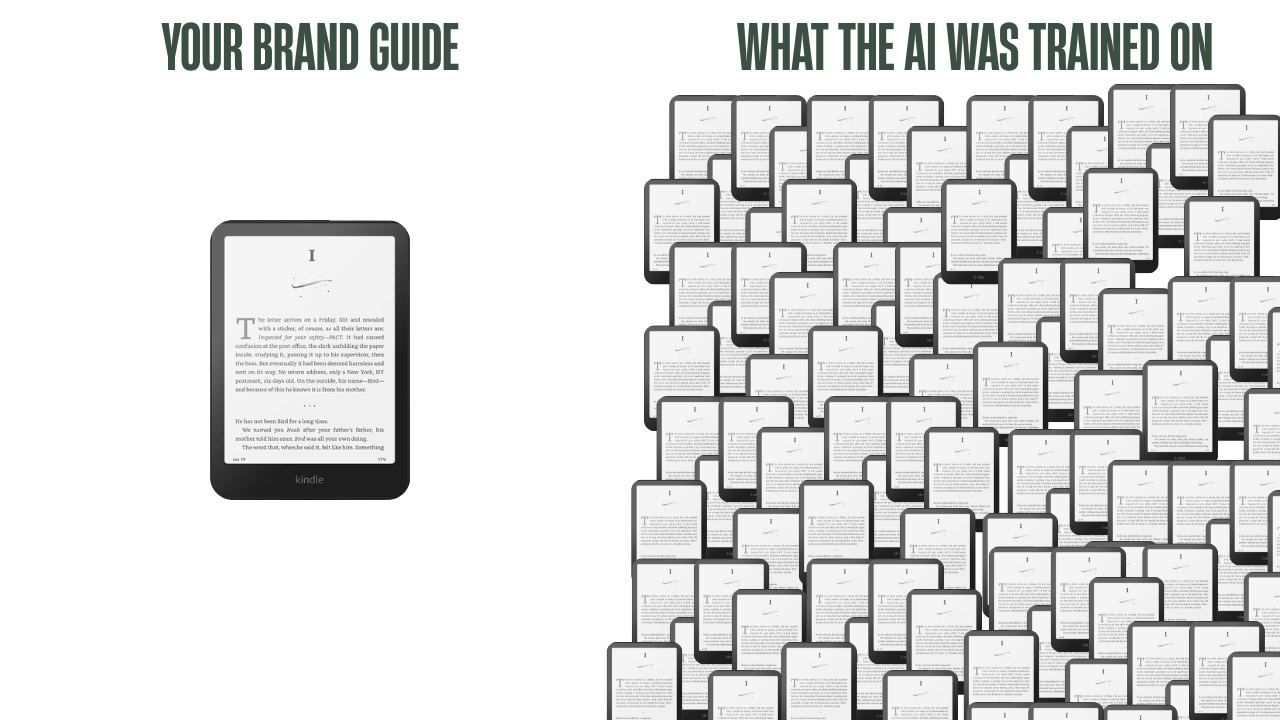
This is one reason why, when you upload your brand guide doc or give an AI like ChatGPT your “master prompt” instructions, it…largely ignores those half of the time. AI-generated content is the result of a machine crunching all kinds of existing text, looking for patterns (word pairs, sentence length, etc.) and then producing what’s most mathematically likely.
You might see courses and guides online that purport to teach you to “train AI” and make the tools give you a specific AI output. But you can’t do that.
If you’re using ChatGPT, Claude, or a dedicated AI content creator app, you’re using a commercially available AI product. Even if you downloaded Meta’s open source model and tried to make it write in an on-brand way, you’re still using something created by a corporation.
The AI is already trained. Training an artificial intelligence model takes an incredible amount of computational power and resources, far more than you or I (or even some of those corporations, really) have the money to access.
Can you retrain your ChatGPT to match a brand guide?
When you upload a request into your ChatGPT memory, for example, you’re not training the AI in any immediate way. Your information may go into its large pool of training data, yes, but your handful of pages can’t and don’t outweigh the vast lake of bits and bytes it’s already trained on.
Think about it like this: if you’ve ever used YouTube, TikTok, or Instagram, you know that the apps feed you content based on what an algorithm thinks your interests are. You can click “thumbs up” or “thumbs down” or “heart” or “don’t show me this” and yes, it might adjust your feed for a while.
But every now and then, you open up your app and see some weird content types you weren’t expecting. You have to start giving it feedback again. Or you click a link to a video that your sister sent you and the next thing you know you’re on some side of TikTok that’s very fixated on painting model cars and that is not at all your interest.
I mean heck, if you’re like me, there’s times when you can’t even seem to get your smartphone keyboard to recognize that no, you do not want to capitalize “WHAT” every time you type it just because you did that once a week ago.
You can think of the technology underlying your ChatGPT or Claude workspace as a similar type of algorithm. There’s programming involved that we, as users, can’t touch. We can give the app feedback in the form of a “thumbs up” or a copy of our content strategy guidelines, but ultimately, our inputs can and will be overridden by the company’s engineers, the foundational programming of the tool, and other bits of feedback we have no control over.
What to do if AI gets your content voice, tone, and format all wrong
If you’re going to use AI for your writing, you must have a human hand in the process in order to get consistently usable content. This might mean only using AI to organize your content marketing ideas, treating it as a basic proofreader for human writing, or using it as a first draft tool and then heavily editing it afterward.
The more AI is involved in the process of content creation, the more you may struggle with getting the right format and style. (You may also wind up accidentally diluting your brand voice.)
The answer isn’t adopting a more AI-styled sentence structure, studying prompt engineering, or having long conversations with the AI in order to “train it.” All you’re doing in that case is stressing yourself out and influencing your individual workspace and conversation, not the way it’ll act forever going forward.
The actual answer is bringing human writers and writing back into the mix.