


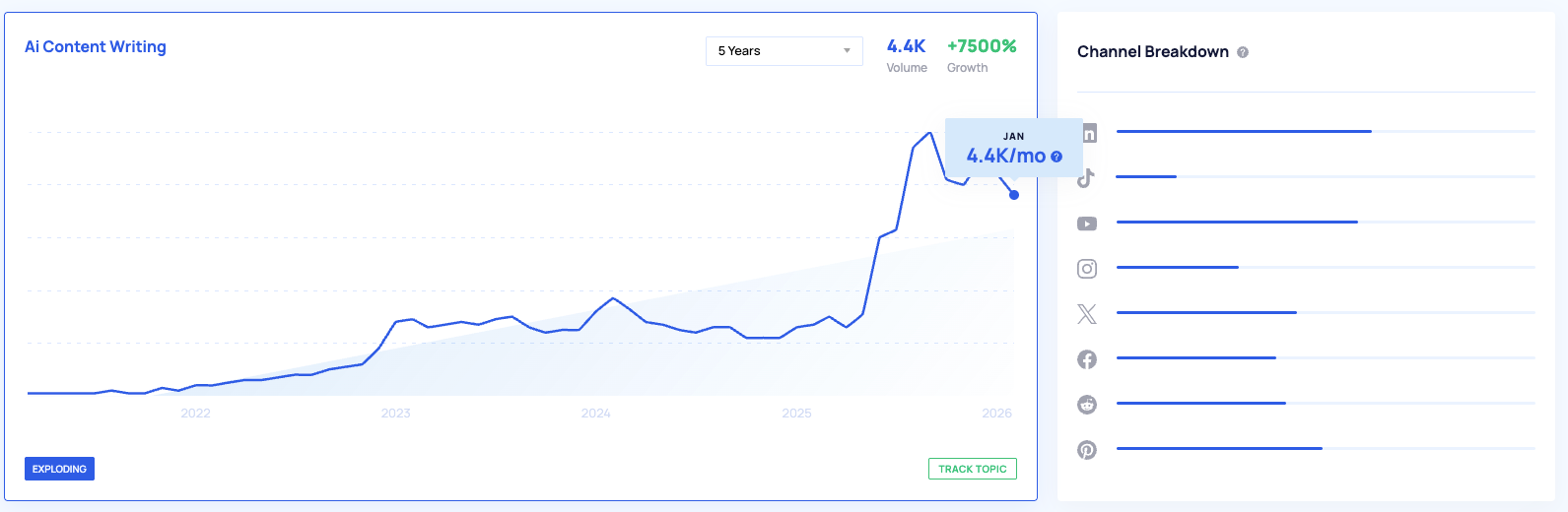
If you search for “AI content writing” on Reddit, there’s a nearly endless stream of results. Most of them are people asking for the best AI to write a certain kind of content; some posts are from people worried about AI making them worse at their craft. And even though AI writing tools have been on the market for years at this point — I made the first version of this comparison in 2022 — it’s still a hot topic in search — just look at this five-year graph from Exploding Topics:
The idea behind artificial intelligence-powered copywriting is simple, and appealing: don’t spend time writing copy or paying someone to do it. Instead, pay one flat fee a month (or nothing! Some are free!) and have a computer write your content for you.
It sounds almost too good to be true...and it is. Kind of.
AI writing can be a real mixed bag
It’s 100% true that AI content creation tools exist, and they do work on a functional level. If you give the AI writer a prompt, it will produce content for you. Whether or not it’s high-quality content you want, though, is another story.
Now, you may be thinking to yourself, “of course you're going to say that, you’re a writer. You don’t want to find your job outsourced to a machine.” And you aren’t wrong, it’s true. I wouldn’t be delighted to find myself replaced by a computer proram.
But, I like technology and I’m willing to admit when I’m wrong. So I tested some AI-generated content tools.
I first did this test in 2022, and found that by and large, the tools weren't ready for primetime.
I tested again for a client in 2024 and 2025. Same result: the quality just wasn't there, especially when you needed to cite a stat or quote someone (even if you provided a transcript to the AI, it would still often fabricate statements).
And now I'm back in 2026, doing the test again.
My first experience with an AI content writer
My curiosity about AI writing began to pick up when I heard about a company that claimed it could create fully unique content outlines for writers using its AI technology. That piqued my interest. I’m wasn't ready to be fully be replaced by a machine, sure, but I figured I could recognize the value in using AI to support my work.
I signed up for the company’s AI content generator tool and prompted the AI to create a long-form content outline based off of a topic I’d already outlined for one of my clients. I wanted to see how it compared to what I put together.
A big problem
What I found was that the program directly copied an article from my client’s largest competitor, including pulling text and headers verbatim from that competing content. I knew this was the case because I had very recently read all of that competing content as part of my research process.
If I hadn’t realized it though, and actually relied on the program to do my blog article outlining, I would have wound up with something probably bordering on plagiarism. Not great for content marketing. Admittedly, the tool was accurate, but to use it would still require a heavy dose of human involvement and intervention.
Testing AI writing tools
That experience left me even more curious as to how some of the other AI-powered content writing software tools I heard about worked in practice. While the original tool I tried was specifically geared toward outlining, I wanted to see what some other programs marketed for full-on website copy creation could produce.
It was at that point I tested several AI content writing tools and found major issues. But that was back in 2022 — it's four years later, AI has evolved, and this blog post you're reading right now gets a good amount of traffic to this day. So it's time to update our little test. Here's how it works:
- I’m using a topic I’ve already written about for clients, have established expertise in, and am known for online: SEO audits.
- I’ll feed a primary keyword on this topic — one I know I can get clients to rank for when creating organic content — into each AI tool.
- I’ll adjust the AI tool’s settings (to the point that its functionality permits). Each tool will be tasked with creating a blog post, not social media posts or landing pages.
- We’ll compare outputs to some original content I’ve written on the same topic, evaluating keyword use, factual accuracy, readability, and tone.
- Both tools that I test are generative and use natural language processing (NLP) to mimic natural human speech patterns.
- Content generation will be from scratch; I won’t repurpose existing content or provide short-form starting points beyond a prompt.
My point of reference for this test will be an article about SEO audits that I wrote for a client. Within four hours of publication, the article:
- Appeared in the top five traditional Google search results for multiple keywords
- Appeared in the AI Overview
- Was cited in AI search chats including those done via ChatGPT
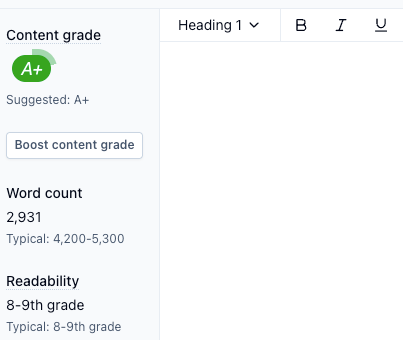
The draft I submitted to my client was nearly 3,000 words long and had an A+ score in Clearscope.
Test subject #1
My first test subject is a paid content optimization platform that can be used to either generate text with AI or gather suggestions for improving the SEO performance of marketing campaign content written by a human. This particular tool has existed for years and used non-generative machine learning to help marketing teams prepare a content strategy or rewrite text. In the past year, though, the platform introduced generative content features powered by large language models (LLMs).
- Intent: Tell the audience how to perform a general SEO audit
- Type: How-to guide
- Tone: Use the tool's default tone (the app advertises this as a 'high performance' tone of voice)
The tool then asked me to choose from a list of pre-written titles and confirm the outline that it put together based on current search results for the target keyword. For the purposes of this test, I didn't change any of the AI's suggestions and used the entire outline that it provided to me.
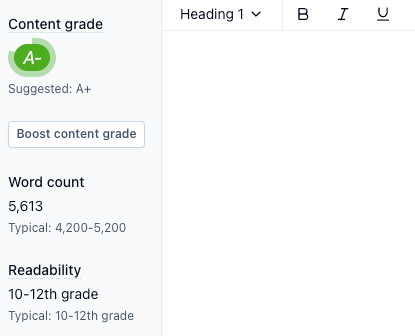
The AI produced an article draft that gets the following score and stats in Clearscope:
Here's an example of some text from the AI-generated article:
Analogy: Imagine you're a detective. Before you start looking for clues, you need to know what crime you're investigating and what you're trying to prove. Your goals give your investigation purpose and direction.
The article followed the same format in nearly every section of the article: subheading, bulleted list, short paragraph, and an "analogy" blurb.
Here's another example from the same draft:
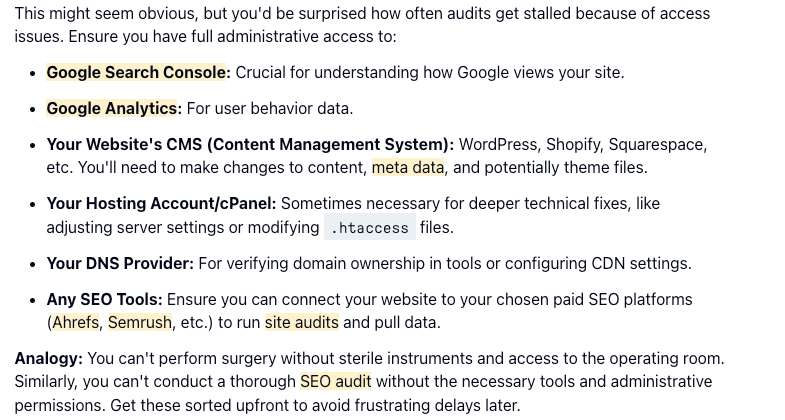
Now, here's the primary issue with this draft: it doesn't target a specific audience skill level. The draft includes top-level analogies that could be used to explain SEO audit concepts to an extremely beginner audience, but then also says that the reader must have access to very technical tools.
One, this is incorrect – you can conduct an SEO audit without configuring CDN settings. The audit informs what may need to change in certain settings or the .htaccess file, but you don't have to make those changes as part of the initial audit.
Two, if the person reading this needs analogies to understand why parts of an SEO audit exist, they're not ready to be messing around in clients' structural website files. And that's okay! But for SEO content to be effective, it needs to be targeted toward a clear audience — and this AI draft isn't.
Another big issue with the draft is how repetitive it is. One problem with AI tools is that they generate filler and fluff to hit a word count, even if the same message could be conveyed more succinctly.
Ironically, to be successful with SEO and GEO content in 2026, you need to get right to the point — exactly what this AI generated text is not doing.
The verdict: Our paid test subject #1 generates a draft that's not too bad, and does use semantic keywords correctly ... but it's much too long, far too verbose, and doesn't consistently speak to a specific audience experience level. This content might look okay on your website, but it's not going to perform well in search over the long term.
Test subject #2
Next, I tried a free AI chat tool. I used this initial prompt: Create an SEO article on the topic "how to perform an SEO audit." Ask me any questions you need to in order to proceed with this draft.
The tool asked me to:
- Specify an audience (I chose marketing professionals)
- Choose a tone (I selected "educational and step-by-step")
- Select elements to include (I chose tool recommendations and a summary or checklist)
Like tool #1, the AI then produced an entire draft in one go. Here's an excerpt from the beginning:
For marketing professionals managing multiple clients or brands, a standardized audit process also creates consistently, helps onboard team members faster, and makes it easier to communicate findings and priorities to stakeholders.
This is a better summary than tool #1 provided, and the general AI chat tool I tested also did a better job at sticking to a tone and audience experience level throughout the draft.
Where this test went awry, though, was in the factual accuracy of the AI-generated guide. Take this chart that it provided as an example:
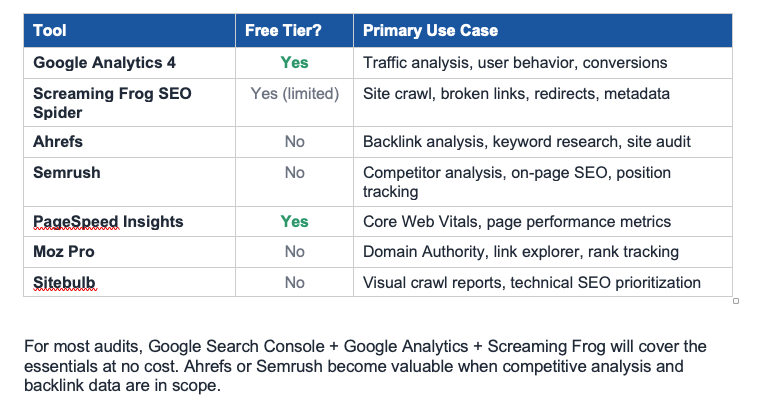
There are several incorrect statements regarding pricing:
- Ahrefs does have a free tier that you can use for audits if you can verify your ownership of the site
- Semrush also has a free tier
- Moz pro may not be free, but there are free Moz tools that you can use
Screaming Frog also happens to be a very technical, not exactly beginner-friendly tool. If I were writing this guide for a general marketing audience — like the AI was supposed to — I'd actually break this recommendation down further and suggest Sitebulb for new SEO auditors; Screaming Frog for folks who already have some experience in this area.
The article also goes on to say that you must use Ahrefs or Semrush in some steps, even though it states earlier on that those tools aren't necessary "for most audits."
The draft didn't get a great Clearscope score for SEO purposes, either. It's missing some key semantic terms and uses more complicated sentence structure than is necessary.
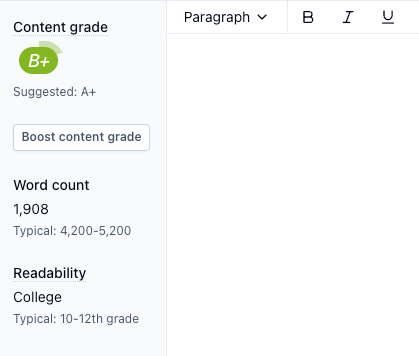
The verdict: While I don't live and die by Clearscope recommendations — there are absolutely times to stick with a lower score or higher reading level — I know from writing content on this topic myself that it's entirely possible to hit A+ without keyword stuffing or even writing 5,000 words. The thin SEO performance of this article plus its factual inaccuracies mean that it wouldn't work well as a driver of organic traffic and could even diminish trust in a brand voice over time.
So... is an AI content writer worth it?
Ultimately, neither of these AI writing tools would serve a website well for SEO in the long term. Tool #1 doesn't stick to a consistent audience and uses a lot of filler; tool #2 hallucinates things that aren't true.
What do I think would happen if you used either of these tools? First, you’d be pretty frustrated. This wouldn’t be a set-it-and-forget-it experience, and you’d need to do a lot of heavy human intervention and proofreading. And seeing as 42% of content creators who use AI to generate content don't do any editing, well, this wouldn't work for them.
Second, as mentioned in my summary of tool #2, publishing content with inaccurate statements — especially when you're explaining a fairly technical process like this — won't get your site cited by search engines / AI tools and it can cause people who do find your content to assume you or your brand don't know what they're talking about. Any rank you get in search engine results pages (SERPs) wouldn’t last very long, and you’d find yourself in a continual cycle of quick spikes and dips: not great for SEO.
What's the best AI for writing content?
Instead of relying on AI-assisted tools to generate actual content, it’s best—in my opinion—to use AI and computer algorithms to make your human-centered content writing workflow a little easier. This could be in the form of automation, research assistance, or scheduling, for example.
Over the past four years, I've tested a variety of AI tools out of my own curiosity and at clients' requests — including Jasper, AirOps, ChatGPT, Claude, Frase, Clearscope (the new content generation portion), and others. I haven't been satisifed with the results for any of them.
I happily use Clearscope's legacy features, as mentioned above, and CoSchedule’s Headline Analyzer to help me speed up the process of comparing my existing content and keywords against other pages in the SERP. And like most folks, I've dabbled with AI-powered proofreading tools such as Grammarly and ProWritingAid. I don't use generative AI to create content, though. I'm still doing all of the drafting, revising, editing, and creating — but I’m able to get some help with the information collection and editing side of things.
There are a ton of AI content writing startups hitting the market every month (many of them using OpenAI's technology), and there may still be a golden goose out there that really can produce optimized content that is on par with what human bloggers create. I haven’t found it yet, but I’ll keep poking around . . . gotta have a heads up when the robots come for my work, you know.
P.S. If you're struggling to write content and have been turning to AI writing assistants for help, I have another solution for you. It's called the Simple Blogging System and it's a way for you (yes, you!) to write blog posts quickly and easily using your own experience and expertise. Initial users of the system's templates wrote 1,500 words in one hour — and the results were better than what either of the AI tools I covered in this review could do.