


The idea that generative AI can speed up the writing process is a common one. Entire companies have been built on the concept of creating large volumes of content quickly (often described as working “at scale”). But the real-world experiences of many professionals is less dramatic, slower, and more frustrating.
What AI tools are people using to create content?
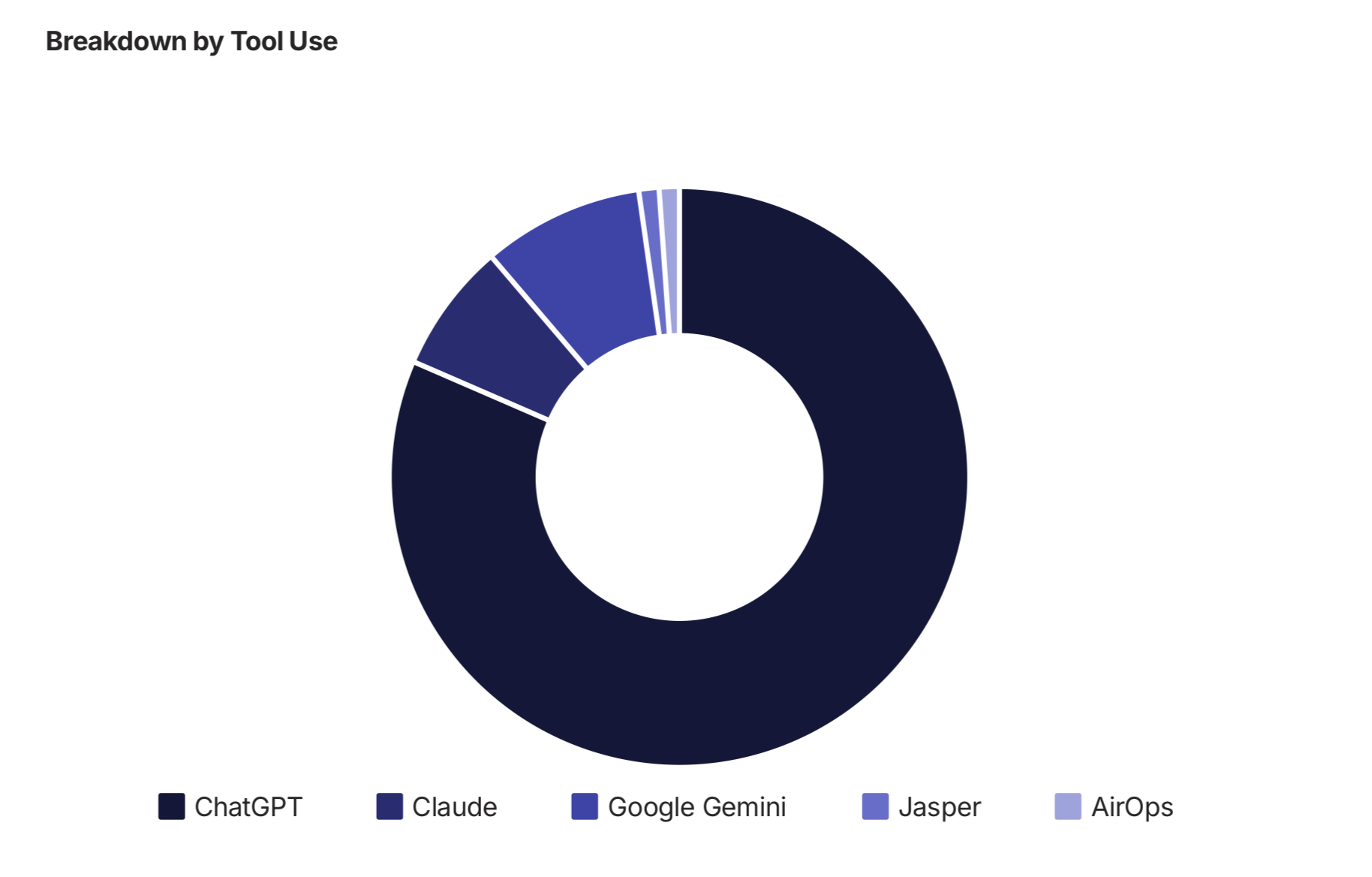
The vast majority of people using AI to create content are using a general-purpose chat tool like ChatGPT, Claude, or Gemini. Far fewer people are using content-specific tools like AirOps or Jasper. This isn’t surprising; the versatility of general-purpose tools means you can use one license for multiple business applications.
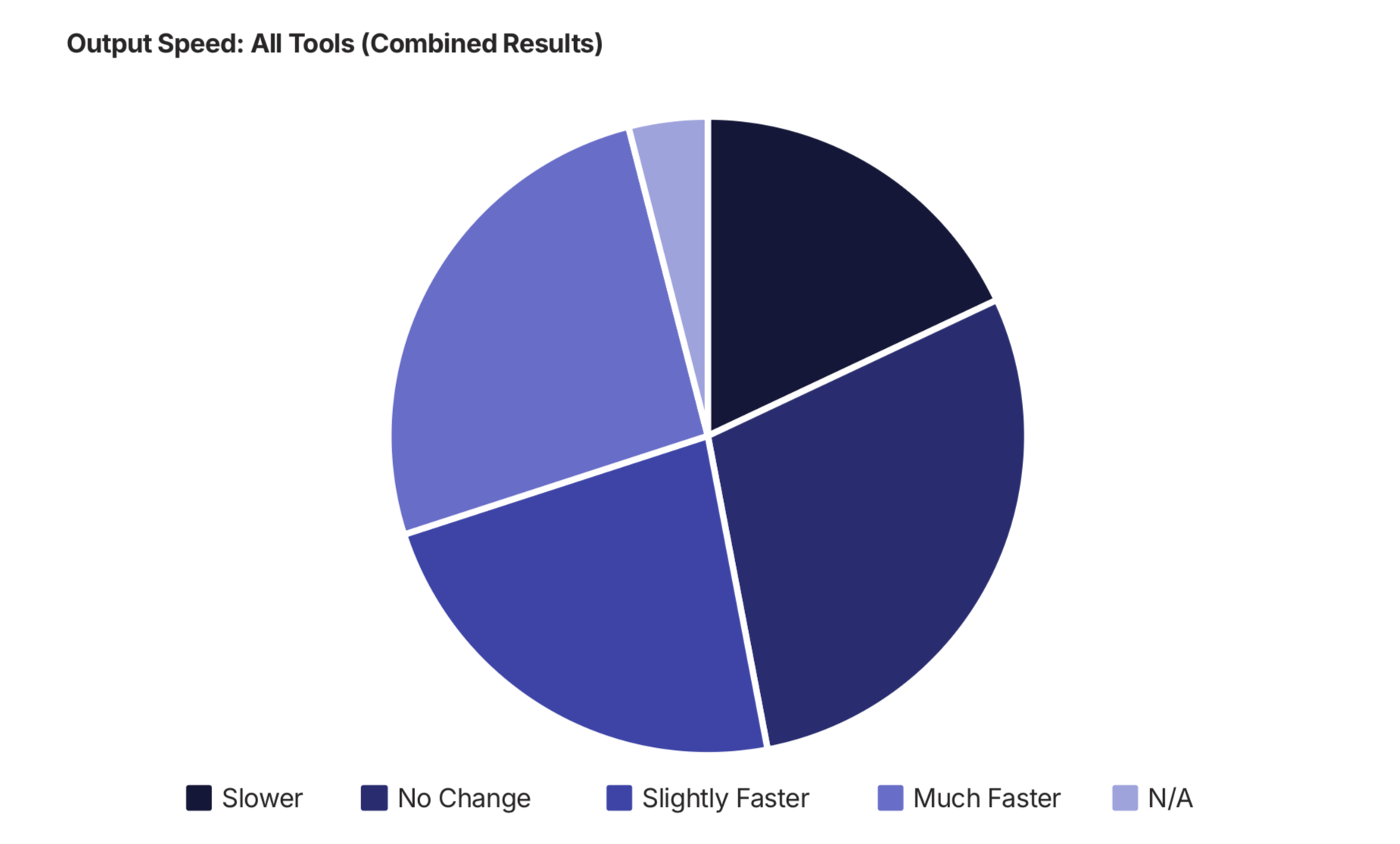
47% of respondents indicated writing slower or at the same speed when using generative AI
Compared to their writing process without AI
Do generative AI tools really help you write faster?
The introduction of generative AI into the writing process doesn’t lead to remarkable speed gains for everyone. Only 49% of people indicate that their AI tools of choice make them faster — and a number of these users are cutting key steps out of their writing workflows.
Additionally, using a content-specific AI tool doesn’t equate to faster production times. 47% of all AI users creating content say that the technology makes them slower or results in no change to their speed (when compared to writing without the help of AI).
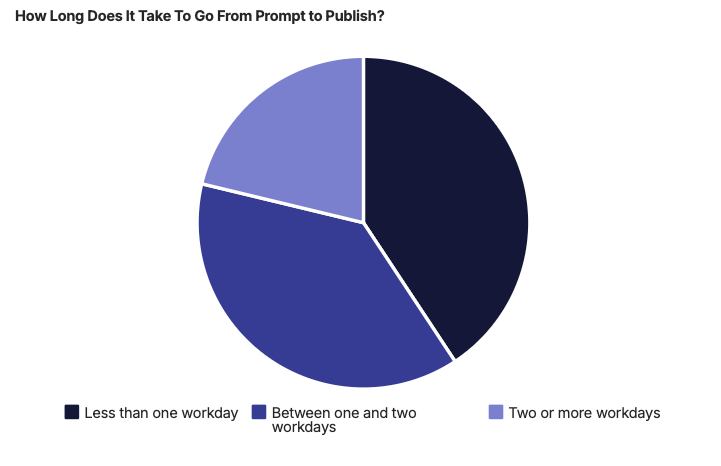
Over 21% of full-time workers using AI to write content spend two or more full workdays
attempting to generate a blog post or article for a website
How do people approach the AI-assisted writing process?
Traditional human-led writing processes often follow a set structure: research, outline, write, edit, publish. While the exact order of operations may vary based on an individual’s preferences, the mere act of writing content from scratch, without the help of an AI tool, naturally introduces planning and revisions.
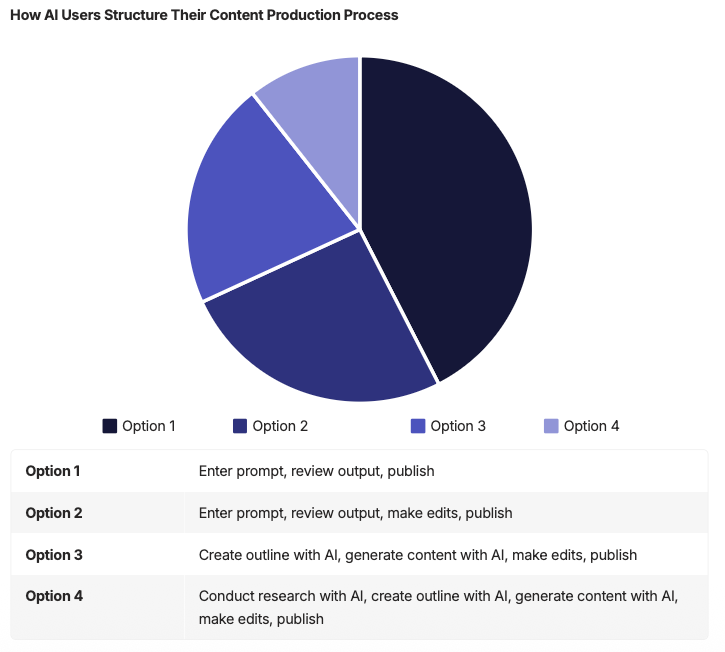
When working with AI, it’s much easier to go right from a single prompt to publication without planning or editing the content — and more than a third of people do exactly this.
42% of respondents do not conduct a manual editing process when writing with generative AI.
How are workers moving from prompt to publish when writing with generative AI?
With respondents being nearly evenly split between working faster and slower / without speed gains, we can see that the core driver behind content production pace lies not exclusively in tools but in processes.
Further questioning revealed that while just over 57% of respondents indicated they did engage in some level of outlining and editing, only 10% conducted research before beginning to prompt the AI and create a draft.
Out of all general-purpose AI tool users, Claude users are most likely to add manual steps like editing into their content creation process. This may be a contributing factor to their slower content production speed than ChatGPT and Gemini users.
| Tool of choice | Less than one workday | Between one and two workdays | Two or more workdays |
|---|---|---|---|
| ChatGPT | 40.86% | 36.56% | 22.58% |
| Claude | 37.50% | 62.50% | 0% |
| Gemini | 50% | 20% | 30% |
(AirOps and Jasper users reported spending between one and two workdays on their content production.)
However, it's important to note that a more involved workflow does not automatically entail a faster prompt-to-publish process. Respondents who skip any editing and planning stages (whether AI-assisted or not) are evenly split between:
- Producing content in less than one workday
- Spending one or more full workdays on their content writing project
| Less than one workday | Between one and two workdays | Two or more workdays | |
|---|---|---|---|
| Enter prompt, review, publish | 50% | 27.08% | 22.92% |
| Enter prompt, review, edit, publish | 41.38% | 41.38% | 17.24% |
| Outline, prompt, edit, publish | 33.33% | 62.5% | 4.17% |
| Research, outline, prompt, edit, publish | 16.67% | 25% | 58.33% |
50% of respondents who skip manually editing their work still spend one or more full workdays creating content with AI
What can we learn from this data?
With more than half of all respondents spending one or more workdays creating content, it's clear that AI companies' advertised promises of speedy content generation aren't quite aligned with most users' realities. And the fact that half of all users who skip editing their AI-generated content still take one or more workdays to produce an output indicates that the problem isn't the tool.
There's a deeper disconnect happening between what people want to write and what AI spits out.
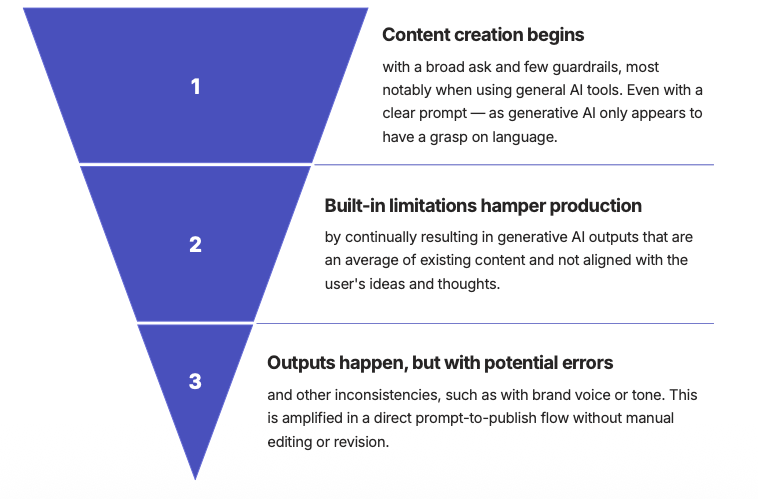
This means that platform choice aside, there are three key points to take away from this analysis of AI content generation process and timing.
AI won't fix structure or process problems
This is why nearly 60% of ChatGPT users spend a full workday producing a blog post, while 45% of ChatGPT users still report working at the same or slower speed than when writing without AI. Not knowing how to format, structure, word, or edit a blog post won't be circumvented by the use of AI. In this case, AI simply speeds up the rate at which each issue occurs.
AI content generation introduces errors
AI hallucinations create errors in content outputs. With more than 40% of ChatGPT and Gemini users publishing generated content without deep edits, this increases the number of inconsistencies and errors published online. While these same individuals may not include a dedicated editing stage when writing without AI, the process of working through ideas and a draft on one's own naturally introduces opportunities for fact-checking and revision.
Removing content production steps doesn't always save time
Struggling with confusing interfaces, battling usage limits, and working around hallucinations can play a part in why skipping planning and editing steps doesn't always lead to faster AI content outputs. A full 50% of people skipping the editing stage still spend more than one full day working on getting content from the AI. This directly links back to the issues with structure and process problems. Just as how AI can't fix process issues, it won't speed up an inefficient workflow, either.
Only 26% of all respondents find that generative AI actually makes their writing process considerably faster
Ultimately, AI content generation is a patch, not a process in itself. Without training and true overhaul of writing processes, blog and article structures, and human-led editing, generative AI merely exacerbates and amplifies problems in a workflow. There's no long-lasting, noticeable correction or fix happening as a result of introducing the technology.
For further reading, including more insights per AI platform and steps to eliminate some of these issues in your own work, grab a copy of the full report: