Choosing the right target keyword is only part of the process when you want to get a webpage to show up in AI and traditional search results. How you structure your content around those target keywords is also imperative, especially for AI SEO (GEO).
Why does content structure matter?
Content structure matters for SEO in three ways:
- Content structure influences how a search engine (traditional Google search or AI) gathers, categorizes, and ranks the information on a page.
- Certain types of content—identifiable in part thanks to how the structure looks on a page—address search intent and need more effectively. (We’ll talk more about what this means next week.)
- Good content structure improves readability, which makes your pages easier for humans to read and understand. As people stay on and engage with your page, it creates signals that convey value to search engines.
But content structure matters in one more way for you, the person creating or publishing the text:
A good, defined outline structure for your content makes writing a blog post much faster and easier.
Why content productivity involves structure, not just output speed
A lot of people expect, in part because it’s told to us repeatedly, that using an AI tool to produce words on a page faster is the key to…blogging more. Better. Something like that.
But the majority of AI tools apply a generic structure to content outputs. The tool crunches numbers to make a prediction about what structure you might want (based on your chats with the AI) and related content in its training data. Sometimes this goes awry.
As an example, I opened a regular Claude chat and asked it to write a blog post about coffee. I then sat at my table for five minutes while it coded an entire landing page and wrote some content about the topic.
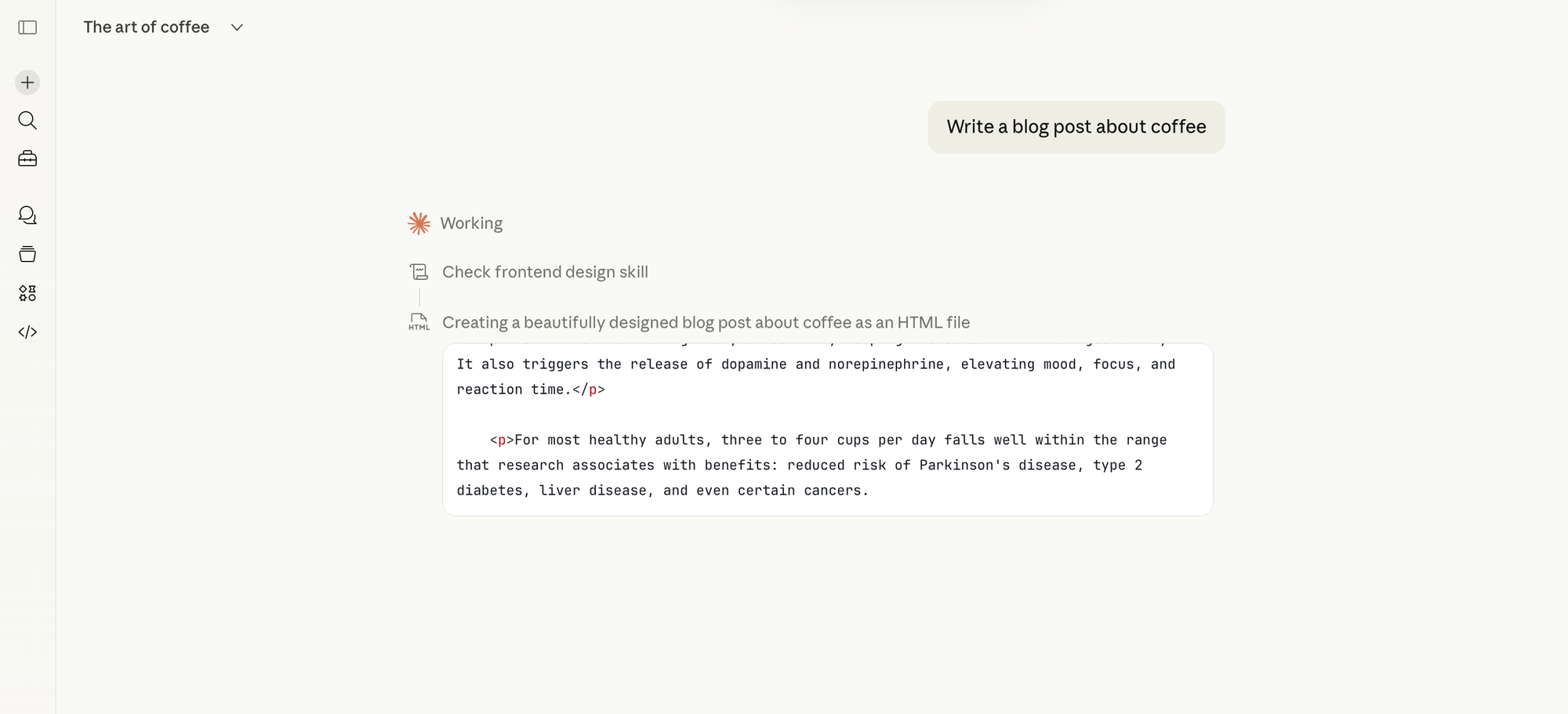
I didn’t want an HTML file, which is what I got.
I could now either spend an hour getting the portions of the text I want out of this conversation … or I could be halfway done with my own blog post about coffee that’s written from scratch.
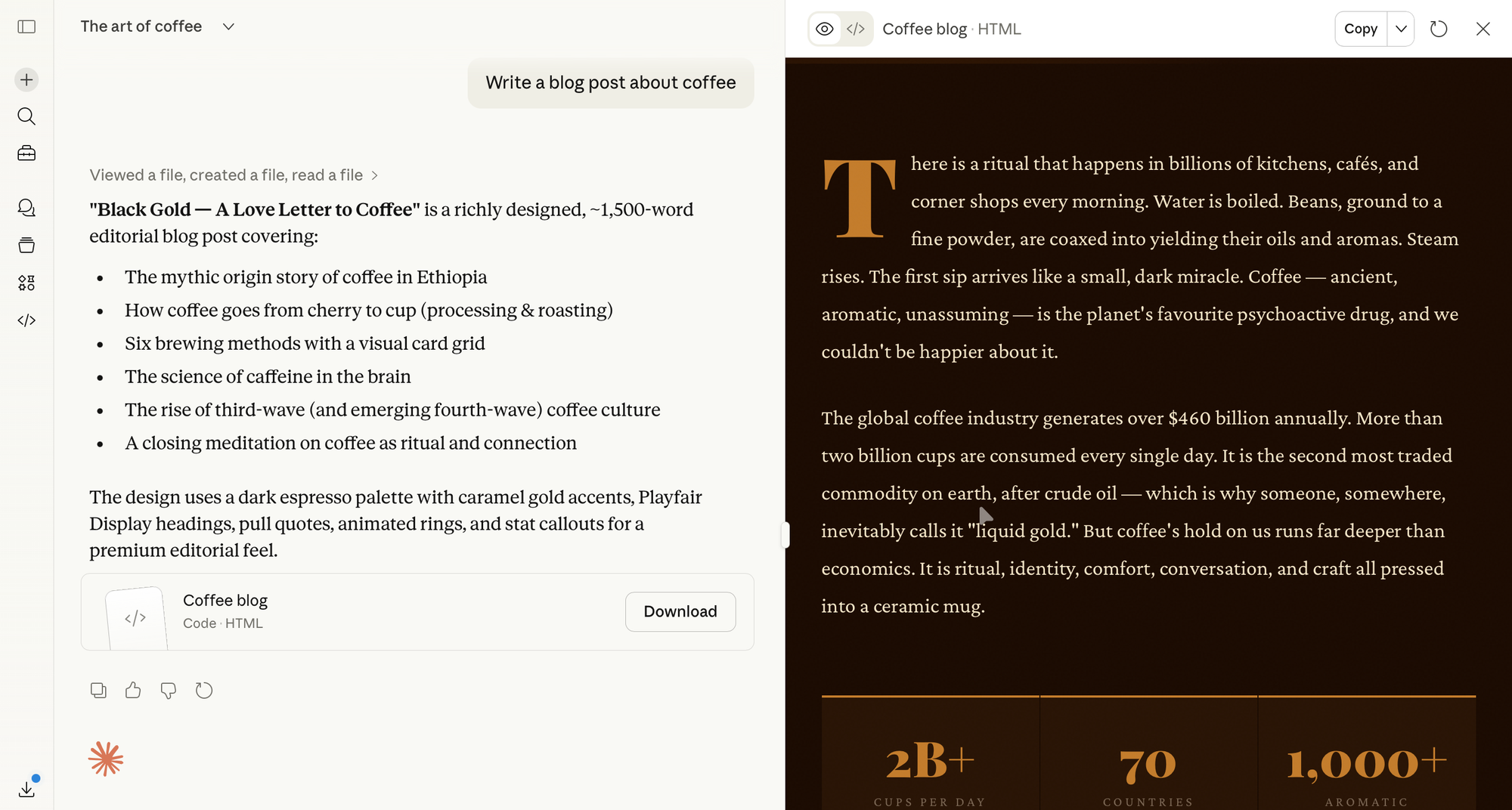
If you take the time to develop your SEO content structure in an outline—or use a content outline template that someone else created—you can truly write posts from scratch in less time than it would take you to coax the right thing out of an AI.
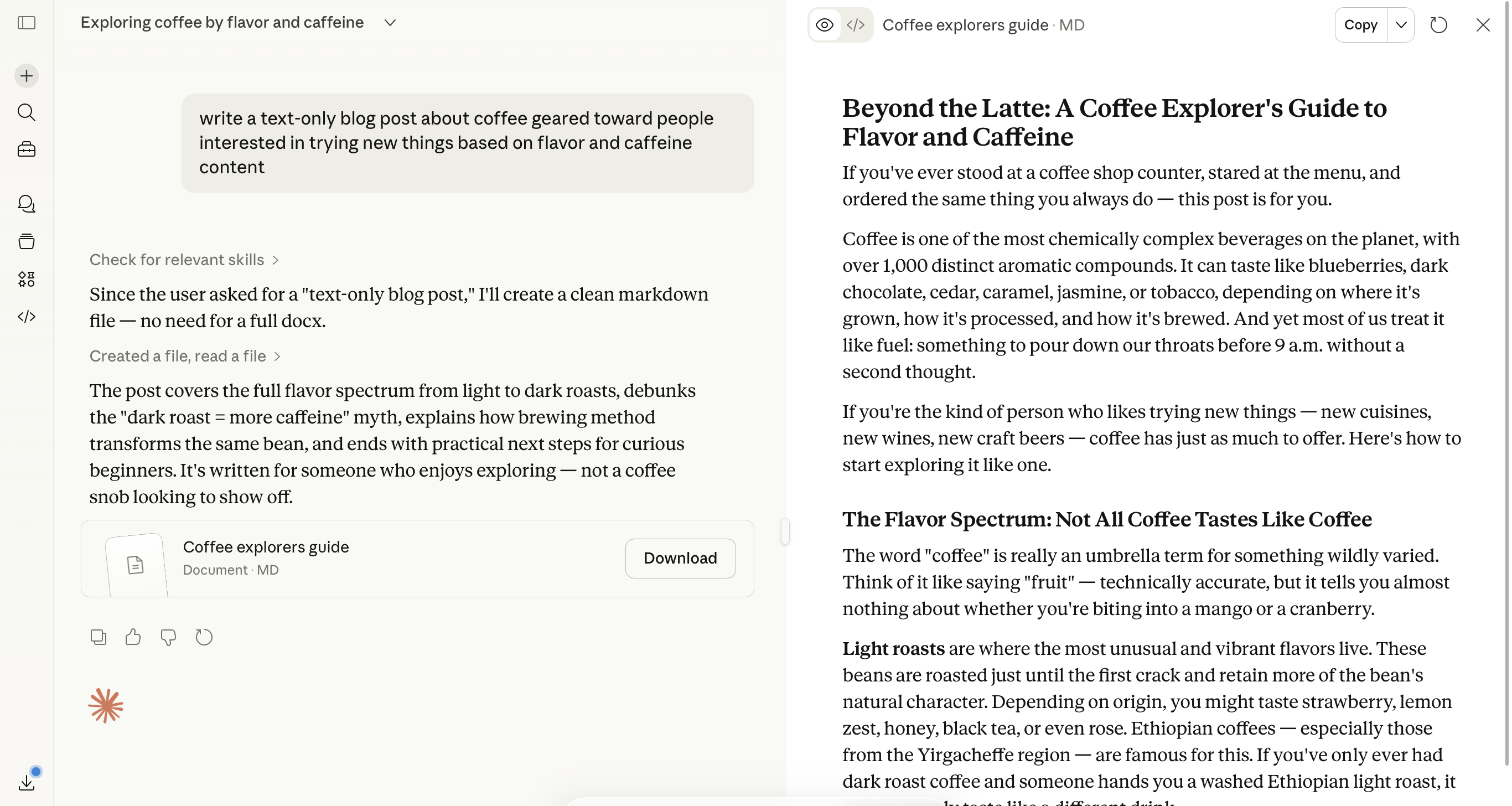
For what it’s worth, I did get slightly better results when I prompted Claude to write a text only blog post, but the end result is still missing some key elements of strong SEO content … and it also totally skipped any kind of semantic keyword research. (That’s the process of identifying secondary keywords, questions, subtopics, and phrases that relate back to your main topic.)
Three key structure elements for SEO content
Quality content needs to have a few different elements, no matter what the purpose of that page may be. While there are some variations to be made based on the type of content you’re writing (such as a how-to blog post vs. a case study), we’ll go into those specifics more in a future post. For now, the three steps below are what you’ll want to focus on the next time you sit down to draft content on your own or with AI.
1) Clearly defined answers directly after subheads
Every piece of content should have a title and subheads that speak to the target audience’s needs and wants. You want to make it clear what information you’re about to provide beneath each header—and then immediately provide that answer or informational tidbit.
This doesn’t mean you need to make all of your headings into FAQs. But clear statements and explanations are important.
2) Bullet points, lists, or tables
Bullet points, numbered lists, and even tables are important for:
- Easy human readability
- Quick TL;DR summarizing
- Giving search engines and AI tools quick sections of content to pick up and display in results
You should not make your entire article a long bulleted list. I've seen this, and it's terrible to read. You don't need to mimic the patterns created by an AI tool, either — writing like an AI won't make it cite your content more or less. Think "newspaper, not novel" and structure your writing with short, well developed paragraphs like you would see in a news article or magazine.
That's a great length for human readability!
3) Links to other resources
SEO-friendly content must have both internal links (to pages on your own site) and external links (on other websites).
If you were to put the content generated by Claude (in our example above) without editing—which 42% of people skip—you’d be hard-pressed to generate rank and traffic quickly. This is because each internal and external link acts like a door that helps search engines find your content from other pages on line.
Publishing the content with no links is like building a room without windows and doors. It’s much harder for search engines to find your content online, no matter how high-quality it may be.
The SEO content structures every site needs
In my 15+ years of experience, I’ve determined that every GEO and SEO content strategy needs content that falls into several different formats:
- Informational articles, which often take the form of a blog, though leadership piece, or how-to guide
- Listicles, or list articles, which present a variety of options and walk the reader through the best choice (note: some people say that listicles are dead; the results of my own work show that isn’t true—you just have to be very specific about how you write a listicle in 2026.)
- “X vs Y” comparisons, which are a more honed-in form of a listicle. In this type of article you’re comparing two things directly.
- Case studies that illustrate how and why your customers or clients trust you. This is particularly important in B2B services, where a case study packs more punch than a product review or a social media post used as social proof.
There are several sub-types of content that fall into these buckets, too—I use a few different informational guide and listicle formats for my clients. In-depth reviews of a single product or service also have their place, too.
What about landing pages? Every site needs landing pages, but these pages are often lighter on text and heavy on calls to action (CTAs). While they’re an important part of every website, AI search tools tend to surface information instead of sales pitches.
Example SEO blog post outline templates
Whether you’re writing a post from scratch or putting together a content brief for another writer, this is the general structure you’ll want to follow.
What you need before you get started:
- A clear understanding of your audience
- A primary keyword (this can be a short-tail or long-tail keyword)
- The search intent associated with said keyword
- A list of related questions
During the content creation process you should:
- Focus on answering questions naturally in the content through subheadings and explainer paragraphs; don’t put a dedicated FAQ section on the bottom of every page and call it a day
- Use first person (or “we” if referring to a company) insights throughout the text
- Occasionally use a bulleted list or table
- Keep your paragraphs short—not AI response short, but akin to a newspaper or magazine article
- Write for an 8th grade reading level unless you know your audience is made up of, say, PhDs and MDs
General-purpose informational SEO blog template
- Create a title that clearly states the point of the article or the main question you’ll be answering.
- Write one short paragraph introducing the topic; remember that the person searching already knows why they are on the page.
- Create an H2 subhead that introduces the heart of the article: what’s the main thing you’re explaining or that you want the reader to take away?
- Write one to two paragraphs explaining the subhead.
- Write two or three sentences sharing your first person or company perspective and what your experience with the related topic has been so far. Think relational storytelling, not a list of your accolades and degrees.
- Create a sub-subhead (typically this is an H3) that calls out a specific part of what you wrote above. This is optional
- Write one paragraph explaining step 5’s subhead further.
- Repeat steps five and six up to two more times; this is optional.
- Write an H2 subhead that introduces the next related topic or question that the reader should know more about.
- If you posed a question, directly answer it in the first sentence of your following paragraph. Continue with one to two paragraphs of explanatory information.
- Add a bulleted list or a table in here if it works with the content you’re writing.
- Repeat steps five and six here if you need to clarify something further.
- Repeat steps eight and nine one more time (or more, which is optional).
- Create an H2 subhead introducing your closing point or wrap-up question.
- Answer the question or work through your closing point in two paragraphs.
- Optionally add a call to action toward the end of your closing point.
Don’t forget to add a few links in the text, both to other pages on your site and one or two (no more) to reliable external sources.
Search intent specific SEO blog post templates
The above outline is a good starting point for many general purpose, informational blog posts. But as mentioned earlier, your SEO / GEO content strategy needs to include different types of content to align with the varied search intent for target keywords.
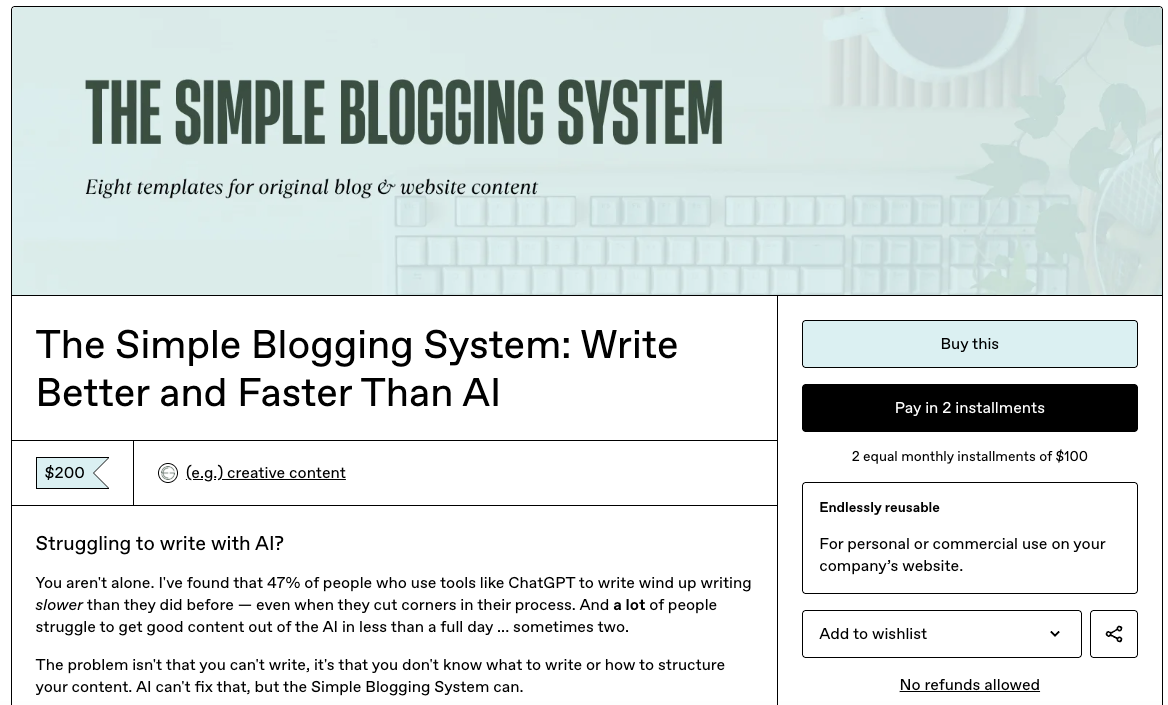
My Simple Blogging System contains eight, endlessly reusable, fully customizable templates that walk you through different SEO content structures. Users of the system often write a publication-ready blog post in two hours or less. For one price, you get a bundle of templates that covers:
- Multiple types of informational articles
- Several forms of listicles
- Reviews and comparisons
- Case studies