There are four types of search engine optimization (SEO) search intent that apply to keywords and content marketing. These different types of SEO intent represent what people typically want and need to see as the result of their search and can include:
- Informational: The searcher wants to find out how to do something or learn more about something specific
- Transactional/commercial: They’re comparing options or getting ready to buy something
- Navigational: The searcher wants to find something specific on your website, like your login page or a particular report to download
- Local: The person wants to examine options in their local area, such as companies that offer home repair services or stores they can visit to try on shoes
A lot of times, people do their keyword research, see the search intent, and then write whatever kind of content they were planning to do anyway. Or do whatever kind of content creation they‘re most comfortable with.
And while you can still see some search engine traffic come into your site from doing this, it’s not the most effective way to leverage relevant keywords and content in your SEO strategy.
How search intent influences SEO content formats
There are certain types of content that perform better that others based on search intent. For example, if you write a long how-to article explaining how to pick the best plumber and hope to rank it for local search terms like plumbers near Boston, MA, it probably won’t do very well in search.
This is because the plumbers near… keyword is used by potential customers who are looking for specific companies, people’s experiences (in the form of reviews and case studies), and contact information — not folks interested in reading a guide on how to pick a plumber. If you need an emergency plumber, you already know you have a problem and require help. You don’t need a tutorial on how to compare service providers.
Similarly, informational searches like how to arrange a small living room will be best served by a step-by-step guide, not a sales landing page.
What type of SEO content to write based on search intent
You easily decide what type of content to write based on the search intent associated with your target keyword and target audience. Check out how search intent and relevant content types align in this little infographic:
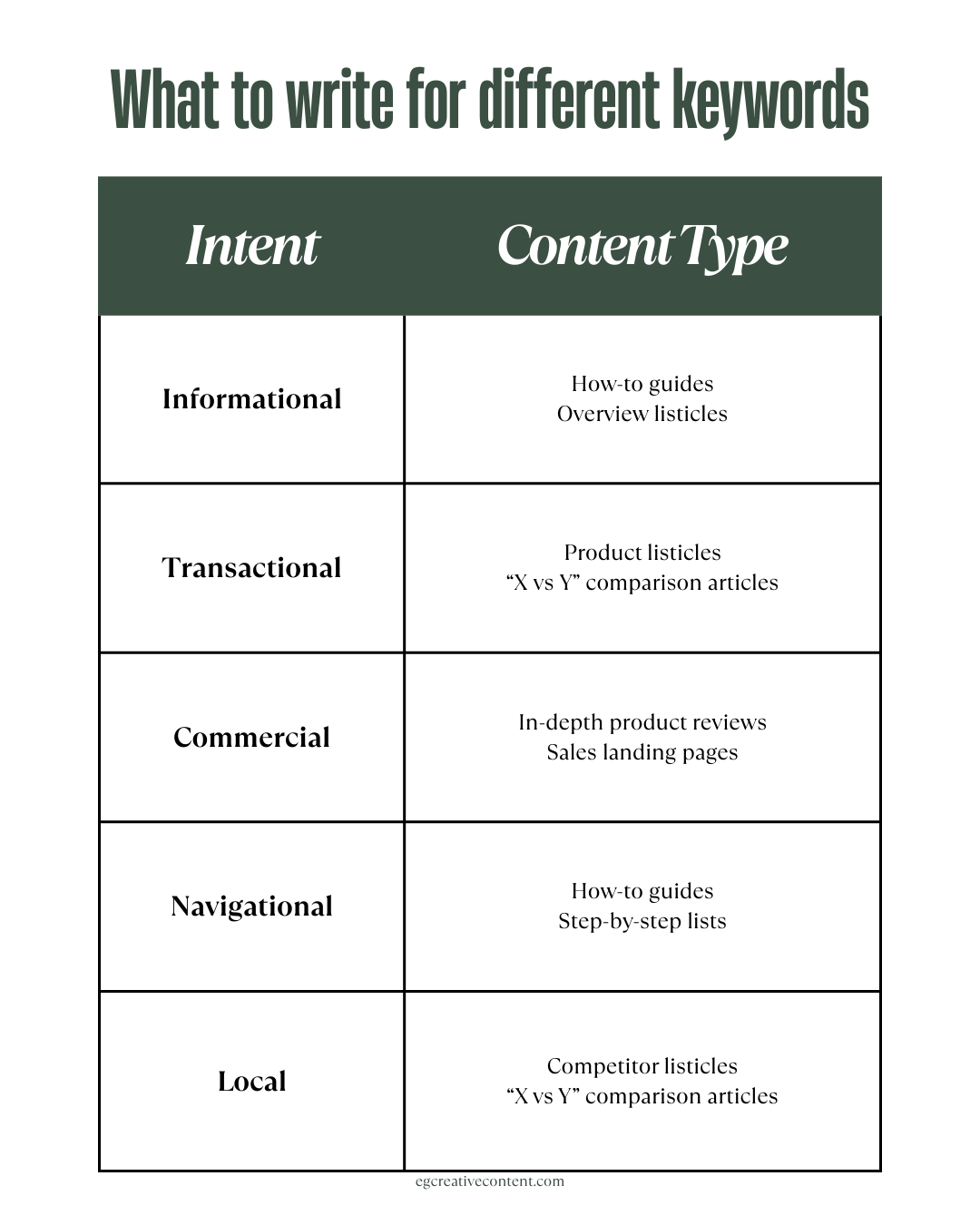
Maintaining a high-quality content mix that covers these different types of search intent can help to drive traffic to your site continuously.
If you’re not sure whether or not you’re correctly meeting the search intent for your target keywords, you can do two things:
- Look at your click-through rate. If you’re trying to target searches across different social platforms, look at how many people are actually clicking on the links you’re sharing. If you’re not getting many clicks, you might be creating the wrong kind of content for specific keywords.
- Check your bounce rate. Your bounce rate is a metric of how quickly people leave your webpages after arriving there through organic search or another link. If your bounce rate is high, it indicates that the website content on a particular page is not aligned with what people want or need. You’ll want to try writing a different type of content for that specific keyword instead. (A bad bounce rate can also indicate issues with your user experience or slow site speeds, so your content strategy isn’t the only thing to consider—but it’s certainly a possible issue.)
- Look at the search engine results page (SERP). A quick scan of most SERPs will reveal similar content across the top results. If you see a mix of how-to guides and comprehensive listicles, you’re probably looking at an informational search term. And if you’re mostly seeing case studies and in-depth product reviews, you’re going to be dealing with a more commercial or transactional search query. And if you’re never appearing in the search results despite being indexed, that can be another sign that your content structure isn’t meeting searchers’ needs.
While you don’t want to rip off any of these other websites directly, creating similarly formatted, valuable content for your website can bring you closer to your target audience, boost organic traffic, and improve your website’s visibility in Google search results.
Can AI pick the right structure for you?
Unfortunately, no. Generative AI tools are pretty bad at picking the right content type for a topic or keyword. These tools are also very bad at picking both short- and long-tail keywords, too.
You see, every time you chat with a generative AI tool, the responses it gives you are predictions based on what it knows about you, what you seem to want, and the previous chats that you have had with the tool. Anything it produces is going to be very tailored to you, not so much your target customer. While AI could feasibly be adept at producing some very short-form content (like captions) or meta descriptions, its SEO performance falls apart the minute you start to get into longer-form content.
If you want to boost your online presence and search engine rankings through content, it’s going to require a human-first marketing strategy to be effective in the long term. (If you haven’t previously taken my AI diagnostic workflow test, the link is below — this is a free assessment that’ll show you where your AI process might be slowing you down and is a helpful complement to what we’re talking about in this article).