


I work with brands in the B2B space. And one thing that I've really been seeing across the board with everyone, regardless of industry or company size, is an uncertainty around when it’s best to use AI in the content process and when it should be avoided.
Because AI is often touted as a good brainstorming tool, many people are inclined to turn to it during the content strategy planning process. But I’m seeing some drawbacks to this approach—and to explore why, we have to back up and look at what’s most important for SEO and GEO in 2027.
SEO and GEO techniques that work in 2027
There’s one really important thing you need to do for SEO going forward, and it’s not anything technical. It’s not adding schema to your site or creating a second text-only version (which isn’t necessary at all). It’s this:
Only publish content that adds value your audience can use.
In the past, it was entirely possible to get content to rank online through traditional search engines by just putting up a landing page that had the right words at the top of it. That’s no longer the case. You have to add real value and insights to the conversation if you want to appear in a search engine results page (SERP) or AI chat answer. You need to:
- Focus on how your content can take the reader to the next step in their process or line of questioning
- Explore ways to add things that aren’t already in the conversation to the SERP page or AI answer
- Identify what your customer isn’t likely to know, but really should be considering
It’s no longer strictly a marketing exercise to put a new page on your website. Yes, yes, we’re doing it for marketing, but it actually needs to provide real information beyond “buy our product” or “hire me.”
You also need to provide as many new insights in your content as possible. That can take the form of original data points or you sharing your real-world expertise.
Learn more: E-E-A-T Your Way to Better SEO
What generative AI is good and bad at doing
You also need to understand what generative AI is good for, and what it’s really bad at doing. Once you have a better sense of this, you’ll find it much easier to understand and decide when and where you might want to put AI into your content workflow.
Generative AI is good at:
- Crunching numbers and data
- Summarizing text
- Repeating patterns
- Running actions simultaneously
In order to create and train generative AI tools, researchers and developers upload loads of data (basically the entire internet at this point) and “show” the AI algorithm how to identify patterns and replicate them. This is why chatting with ChatGPT feels like talking to a person—it’s correctly guessing what words a human would be likely to string together.
And because generative AI is a computer, it’s good at running multiple actions all at once.
Knowing this allows you to find some spots in your content strategy process where AI might be useful, such as taking a massive spreadsheet full of questions and keywords and grouping them into clusters based on similarity.
Generative AI is not good at:
- Creating new concepts
- Developing fully unique ideas
- Quoting people accurately (even if you give it a transcript of a conversation)
Granted, when you chat with an AI tool, it may present topics or ideas that feel new to you because you personally haven’t thought of them yet. But ultimately, the ideas aren’t new—they’re pulled from, and remixed from, all of the data that the tool can access in its “memory” and online.
I’m not here to tell you that marketing is always about new stuff, it isn’t. There’s only so many ways we can all sell the same stuff. But the issue with generative AI is this: if you’re only relying on AI to produce your content strategy—to tell you what to write—then you’ll likely be edging very close to what other people are talking about. And I don’t just mean ideas. I’m talking about accidentally replicating or nearly replicating their words.
You and a marketing manager at a competitor across town might both be focused on creating content around the same topic because it’s important to your shared customer base. But if you produce content plans separately, and through your human brainpower, you’re going to talk about the topic differently based on:
- Your individual experiences
- The way you interpret things around you
- What your customers have said
- Specifics of your product or service
- The way you personally process language in your head
- Different lived experiences
But if you and that other marketing manager are both relying on Claude to tell you what topic to write about and how to write about it, you run into the issue of your content plan and words becoming a lot more similar than they would’ve been otherwise. You’re stripping away the unique lenses you each bring based on your differences in company operations, customers, and personal experiences. Instead, you’re now producing something through the shared lens of a single AI chatbot.
Related:Why updating your AI chatbot’s memory isn’t enough to make a real difference
When you’re chatting with an AI and asking it to guide your content strategy, you’ve now flipped the script from you prompting the AI to the AI telling you what to do. You’re taking instructions from the bot.
Do you really want to spend your day taking instructions from a computer?
The Associated Press publishes a style guide that’s used by news organizations and writers around the world. They just released an update explaining problems with AI and content generation, and one of the specific things they called out was that while chatbots might excel in spelling and punctuation, they might make errors in logic or common sense that can be hard to notice.
A chatbot might present you with a list of topics to write about, but there can be logical errors in why it’s picked those topics. You might not notice the issues right away, which is understandable—you’re busy and you’re looking at this list of ideas as a discrete thing. You’re focused, in that moment, on generating a list…and it gives you that.
But those publication topics might not actually be the best or right course of action for you to take over the coming months based on other market factors, community issues, economic forces, and more. It’s hard to see when you’re just looking at a list that’s been presented to you devoid of any other context.
Do I recommend using generative AI for content strategy?
Honestly, no. AI is good at making connections between existing points, but not new points entirely.
When you solely rely on what generative AI is telling you to write about, the topics and structure it recommends are going to be very similar to what already exists…and what other people are planning to do through using the same tool as you.
This is entirely the opposite of what SEO requires you to do for success in 2027: bring something new and valuable to the conversation online.
Following an AI strategy is going to keep you very close to what already exists in search results. In order to stand out, you have to be able to look at results yourself and think:
- What isn’t here?
- What can I add based on my own experience and products or services?
- What can I bring to the table that other companies don’t offer?
- What have our company’s clients communicated to me that might be different than what a competitor’s clients are feeling?
Let’s take a look at how AI use in the content process has affected some actual websites.
Example 1
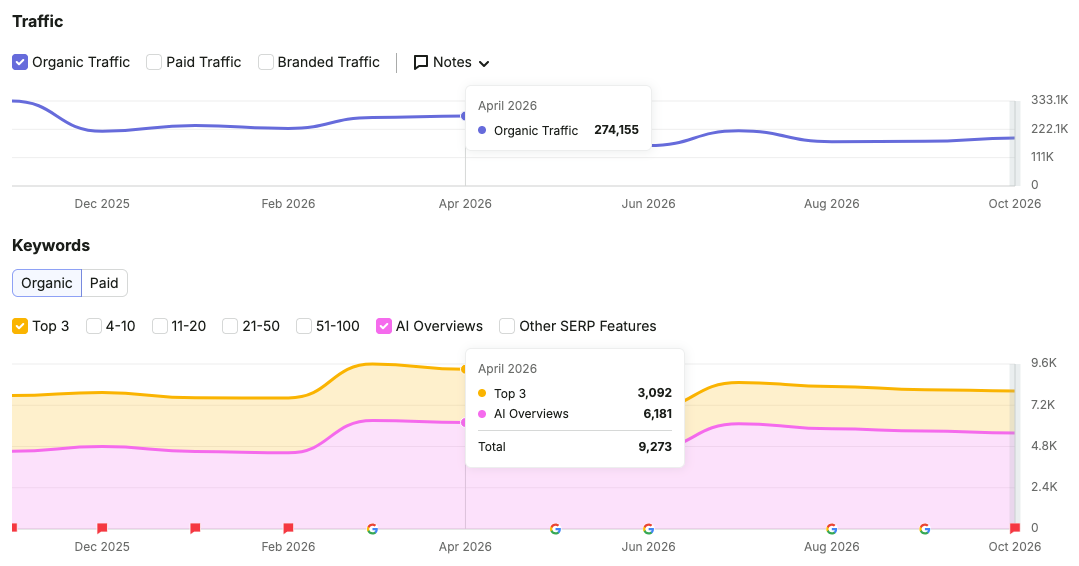
In this example, we’re looking at a large company website that used to have an entirely human-driven strategy and content writing process. There was a shift in their new content production earlier this year, and new blog publication appears to be largely driven by AI (both strategy and content updates/new articles).
First, we can see that their site was doing pretty well with its fully human approach, getting nearly 275,000 blog visitors and holding over 9,000 keyword spots in the top three + AI overview at their 2026 peak.
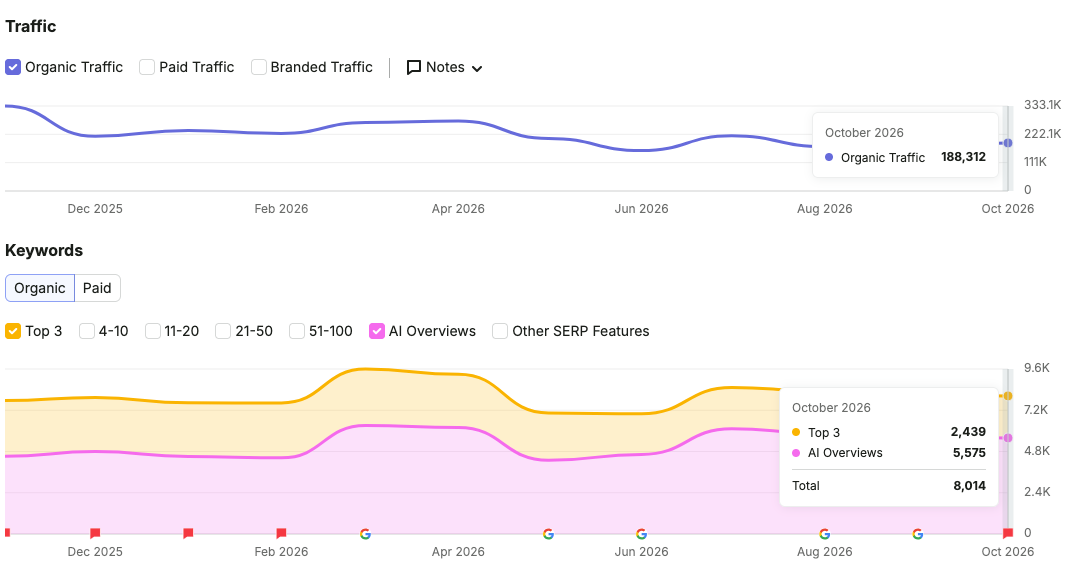
But if we look at the blog now, when they appear to be executing an AI-first approach, we see that traffic has dropped below 200k visitors per month and they’ve lost nearly 1,000 keywords in those top valuable positions.
Example 2
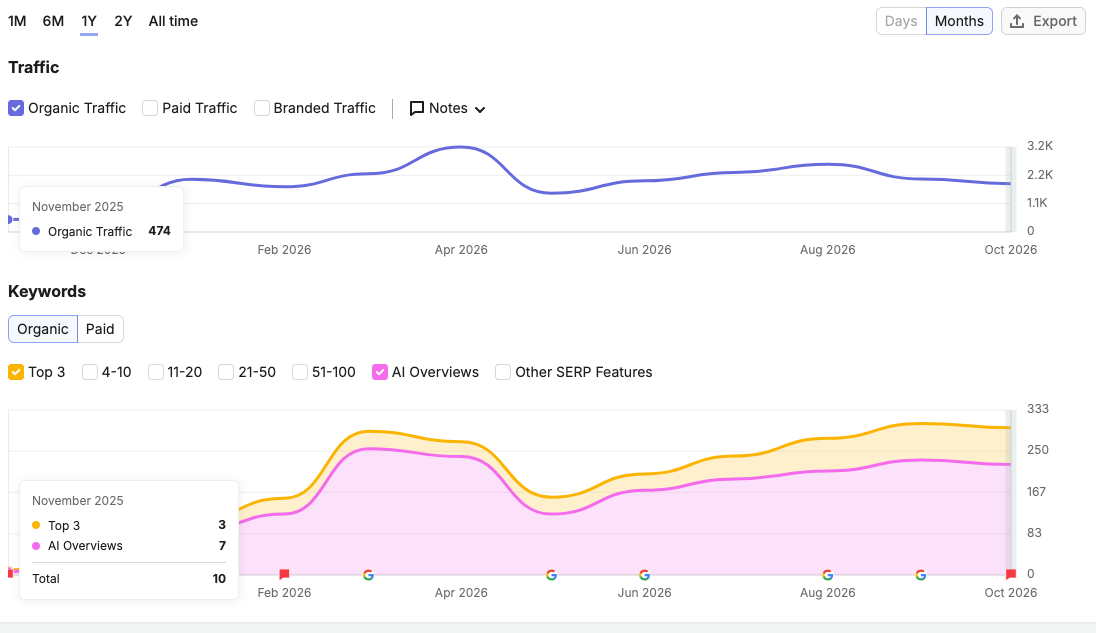
Now let’s take a look at a site that uses a human-guided content strategy (and has good human-written content that adds a lot of E-E-A-T to the site).
When this site launched last year, they had low traffic, simply due to how new they were.
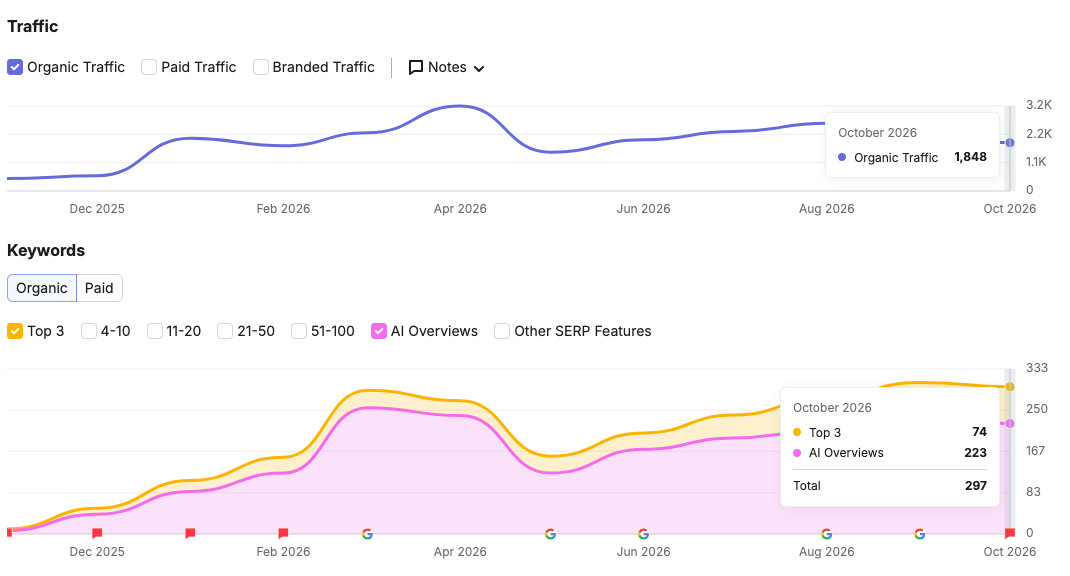
But in less than a year, they’ve steadily grown traffic (yes, there were dips and peaks, but this is normal for a new domain). And they’ve gained almost 300 top keyword and AI overview spots in the Google SERPs. That’s honestly very impressive for a new domain and a smaller company.
Example 3
For our last example, we’re going to look at my website. I’m one person running this domain, and high traffic volumes aren’t my number one goal (since I’m not selling ads or a product, I spread my marketing efforts and lead acquisition work across organic SEO, LinkedIn, and referrals).
My site is almost entirely a blog and I use no generative AI in my content planning or writing process. Earlier this year I switched from posting monthly to posting almost every week. And despite the increase in AI overviews in search—which can take traffic from sites—I’ve seen continued growth in:
- Organic traffic
- Keyword positions I hold in the top three spots
- The number of AI Overviews I appear in
Posting high E-E-A-T, human-crafted content nearly weekly has raised my traffic from about 200 visitors per month to over 800 just from organic search alone.
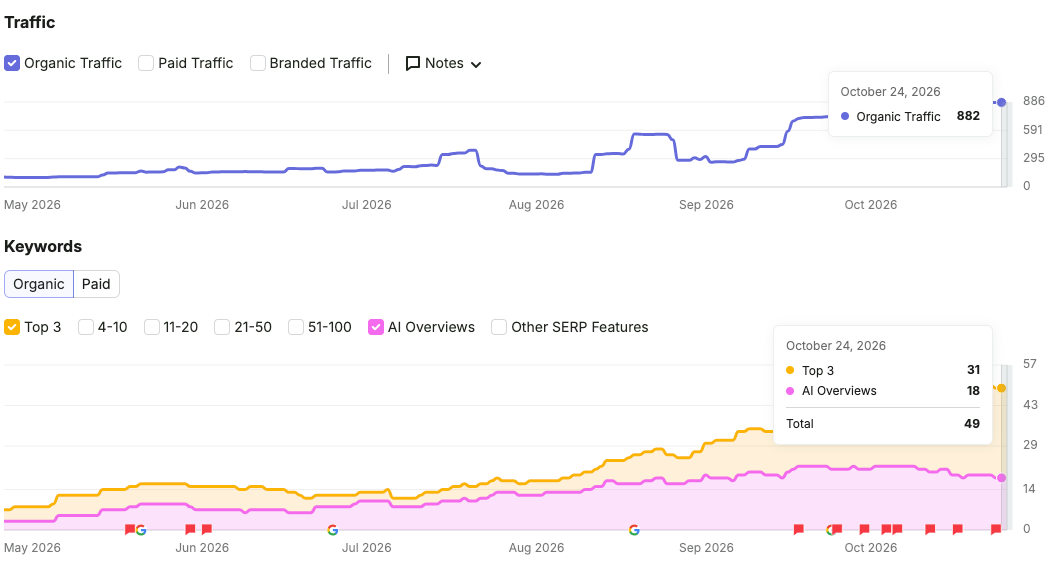
My total monthly traffic is over 1,000 visitors per month as I get clicks from other websites where I’ve been a guest contributor, LinkedIn, and AI tools including ChatGPT, Gemini, and Claude.
Does AI SEO success require AI use?
A lot of people have the misconception that AI likes AI and say “if you want to attract AI to show you in search results, you need to use AI” …or some variation on that statement.
That’s actually not the case, though. It so happens that AI search algorithms are actually focused on delivering what people like. Because if they can keep people happy with the results, people will keep using the platform. They’ll see ads, and they might even sign up for a paid subscription.
Piss people off with bad results, and none of that happens.
And people still like content that’s produced by people.
The non-SEO reason you shouldn't only use AI for content strategy
Finally, even if you’re like “hey, Emily, I legitimately do not care how close I am to other stuff in the search result, I don’t care about my organic traffic, my content is for existing customers and for use as sales team assets,” there’s one more reason why you shouldn’t let AI fully dictate your content strategy:
A lot of AI companies aren’t actually doing well in terms of actual profit. According to Investor’s Business Daily, Anthropic (they make Claude) lost $80.7 billion dollars in the first half of 2026. That means they lost more money than every other major company on the market. EVERY SINGLE ONE.
If you’ve completely outsourced your content strategy process to an AI tool, well, what happens if that company goes under or has to raise the price of your subscription by an unsustainable amount? Would you be able to afford to hire someone to fill the gap, or do it yourself? Would you still have your content strategizing skills?
Unfortunately, switching to a smaller content-focused tool isn’t a safety net answer either, as the majority if not all of those specialized platforms are built using OpenAI and Anthropic technology.
If you have a 100% AI-directed content strategy, you’re left with:
- Less-original plans and topics
- Potentially lower organic traffic over time
- A risk of losing your plan and processes if the tool goes away or becomes too expensive
And you know, switching to a content only tool isn't really a full safety net because all of those tools are built on top of common AI frameworks, typically ChatGPT, sometimes anthropics Claude. And if you have a hundred percent content strategy, you're left with l fewer original plans, possibly lower traffic as we've seen, and you you run that risk of losing your plans and your process and your whole tech stack.
Keeping a balance between human and AI skills in content strategy
If you choose to use generative AI, just make sure to keep a balance. Try:
- Doing full ideation yourself or with your team to build out your content topics, keeping them as unique as possible
- Figuring out how to add E-E-A-T into those topics
- Using AI to help double-check some research, organize topics into groups, spellcheck, or scan your website for suggested links you can add into new pieces of content
And whether you want to go full AI or keep that balance, make sure you diversify your tech stack. Don’t only use one tool like ChatGPT—if it goes down, even for a day due to technical issues—you’re going to be stuck.
I was once at the airport when a technical issue took down every airline's booking systems except for one: Southwest. They were the only airline using an older, different system. And they got all the business that day.
I’m not saying rely on old tech, rather, make sure that you aren’t so dependent on the One Big Popular AI Tool in your industry that you’re grounded without it.
For example, you could brainstorm ideas with your team, ask Claude to organize those ideas into a calendar, and then generate some top-level bullet points to add into your content briefs. This way, you’re not taking direction from the machine, and you’re not entirely dependent on it if you’re locked out for some reason—you can still get your work done.
Ways to diversify your content strategy tech stack
I recommend trying out these tools to make sure you aren’t using generative AI for everything.
- For topic generation: Answer Socrates or AlsoAsked
- For exploring your competitors: Semrush or SE Ranking
- For finding internal links to add to new content: Ahrefs or Screaming Frog
- For easy and cheap keyword research: Keywords Everywhere
These tools aren’t all built using OpenAI or Anthropic tech, either, so if one of those platforms goes down you won’t be fully sidelined.