


While keywords haven’t gone away, there’s a second element to SEO that’s increasingly important right now: entities.
Entities are the specific topics that can be associated with your website. More crucially, they’re the topics that AI search platforms associate with your website.
Entities and their relationships to keywords
You can think of entities as the overarching umbrella over pages on your site, with keywords falling under each one:
- Entities
- Keywords
- Questions
- Subtopics
How entities should impact your SEO strategy
There are two ways entities can directly impact your SEO strategy:
- You can assess your current website entities to better understand how AI search engines understand and categorize your content
- You can target specific entities through future content creation efforts, adjusting future AI entity recognition and your placement in search results
In short, if you check your current entity associations and feel they aren’t relevant to your website and audience, it means you need to adjust your content focus.
And when you pick the entities you want to be associated with, then find related keywords and create content, you can improve the way in which search engines like ChatGPT and Google’s AI mode understand and show your site.
Creating an entity-based SEO strategy
Adding entities into your SEO strategy doesn’t require totally reinventing how you work. You just need to make some slight adjustments.
1. Understand what entities are associated with your site
The best way to find the entities associated with your site is to use an SEO tool. Waikay has a nice visual way of illustrating entities, while Semrush uses squares of varying sizes to show how closely an entity is related to your site:
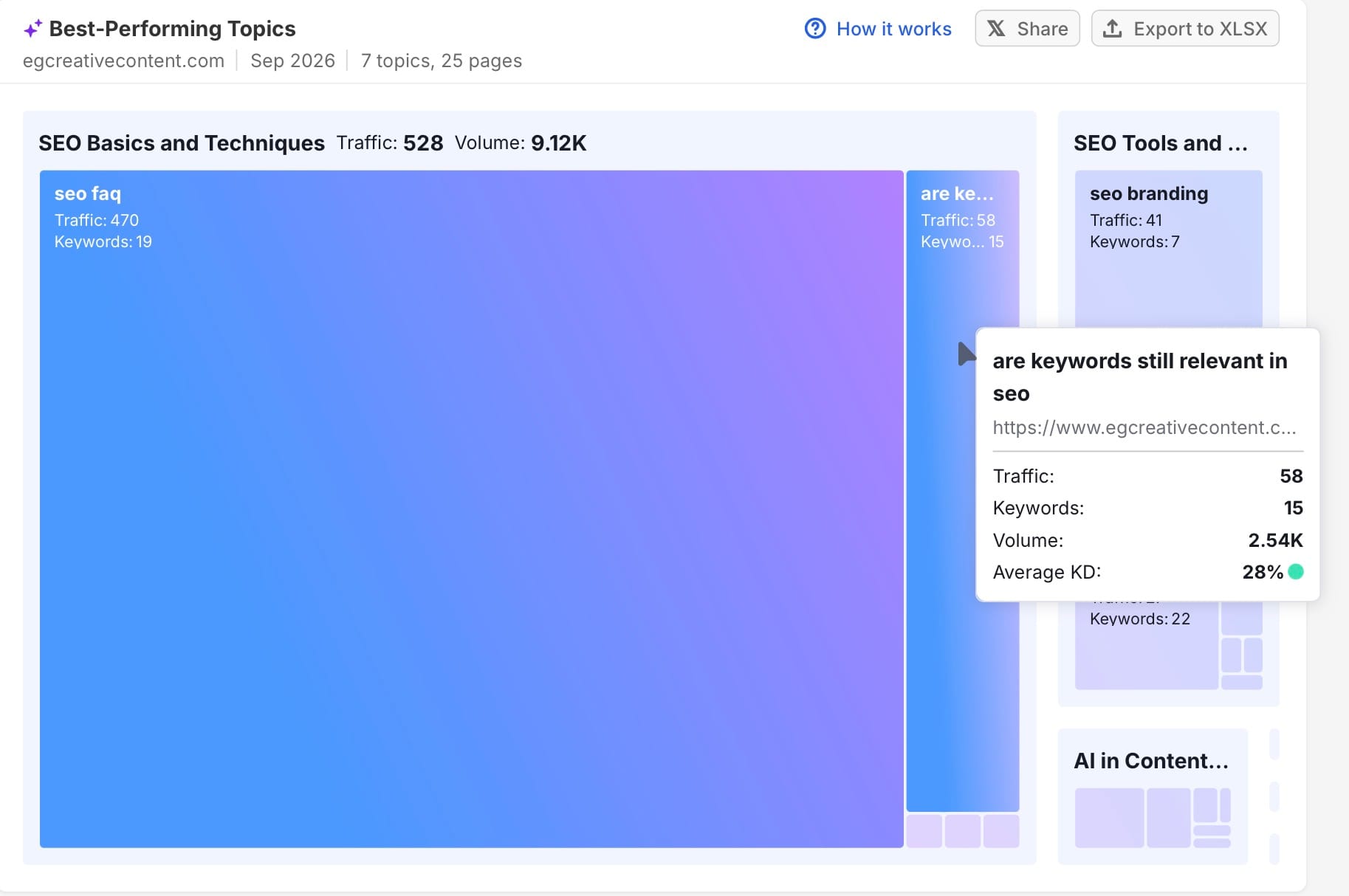
There are some free tools that claim to assess entities, but I have largely found these options to be limited in information or difficult to use. If you don’t have access to an SEO tool, you can try putting your most critical webpages into an AI chat and asking what topics the AI picks out of the content.
If you want to go that route, you’ll want to repeat the process across several major AI chat tools to get the most accurate result.
2. Evaluate how accurate your current entities are
Take a look at your entity list—or the entities that are most commonly surfaced across various AI chats—and think about how well they represent what your website is known for…or what you wantyour site to be known for.
If you do agree with your current entity list, skip ahead to step four.
If you don’t like the specific entities that are associated with your site right now, move on to step three.
3. Make a list of the entities you do want associated with your site long term
If you’re not happy with the type or breadth of entities associated with your website right now, you’ll want to conduct some research to establish what entities would be better for your content.
You can:
- Repeat the scanning process you used in step one on some of your competitors’ sites and see what entities they’re associated with. Jot down any that you would like your own site to develop an association with, too.
- Evaluate your target keywords, then work with your team to group keywords into related categories. Give each category a label—this is the entity you’re going to target.
- Use a topic tool like Exploding Topics to explore what’s trending in your industry right now and group those trends into related buckets just as you did with keywords. Once again, assign a label to each group and treat that label as your target entity.
4. Find keywords associated with your target entities
You’ll now want to research what keywords and questions are linked to each of your current or target entities. (If you started with keywords and worked backwards to entities in step three, you may be able to skip this step.)
For example, if I am working on a site with entities like:
- Affordable marketing
- User-friendly marketing tools
- Marketing tutorials
Then I’d want to figure out what people are asking search engines—either single words or full phrases, the latter of which is more common now thanks to AI search.
AlsoAsked is one of my favorite tools to use for this purpose, as I can type in any topic and see loads of related questions people might ask an AI system.
5. Plan content around each entity
Use the keywords and questions you’ve uncovered to:
- Evaluate how well you’re currently answering all of the questions related to your target entities
- Get ideas for improving your existing content by adding new topics or questions (and their answers) onto a page
- Identify content gaps that you need to fill by creating new content about a specific topic
This is where the process begins to turn into more “traditional” SEO and content process that you’re likely already familiar with. The difference is, though, that you’re not thinking of one single page influencing one single keyword. You have a variety of pages and keywords that influence an overarching entity and make sure it’s associated with your site.
Be sure to add lots of internal links on your old and new content as you work through this process. Creating connections between pages will help improve the way search engines understand how your content relates to a singular entity.