


AI search visibility feels like a big, confusing, gray area to a lot of people, including, possibly, you. And that's absolutely understandable. It's just a big old mess of companies saying their specific tool is what you need, so-called "experts" claiming you need duplicate copies of your website that machines can read (you do not. Large Language Models—LLMs—can read your website exactly as it is) and everybody's selling you some sort of fix.
But you don't need a specific fix, not yet. You just need clarity around which AI search tools are showing your site in results, how they're showing your site, and what kind of prompts drive these search appearances.
With that information, you can figure out if your current AI search traffic is qualified or if you need to do work to fix how LLMs talk about your brand. And then you can begin planning how to increase the number of times you're mentioned or linked in an AI search result.
You just need data.
TURNing AI Search Confusion Into Clarity
I've spent the past four years working on ways to make it easier and clearer to find out when and how AI tools mention brands in search. Much of this work happened in the course of providing my Stress-Free SEO Strategy service to various businesses, as that service takes a look at both traditional and AI search positioning.
But I wanted to go deeper and isolate the AI analysis portion of my work so that I could more quickly determine current positioning, provide clarity around traffic quality, and produce data on LLM search competitors.
Enter the TURN analysis technique.
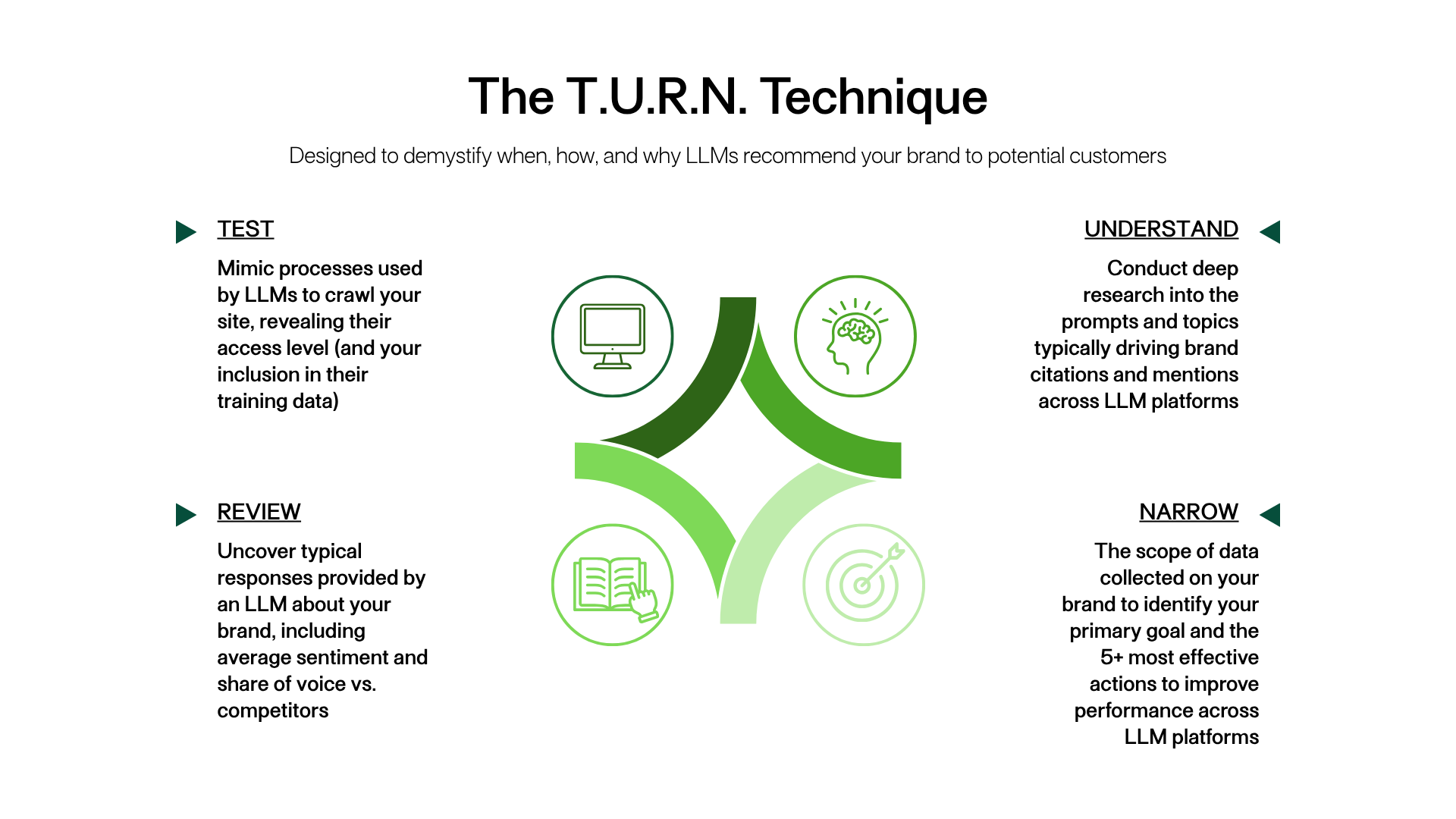
The TURN analysis process does four specific things. It:
- Tests how/if LLMs access a website and evaluates whether a site is in LLM training data. If an LLM search crawler can't access a site, it won't appear in tool's search results. It's as simple as that.
- Understands what prompt topics typically drive mentions and citations (aka links) for a website across AI search results.
- Reviews the average sentiment of LLM mentions and a site's share of voice in results (versus the competition).
- Narrows the above findings down into actionable steps that help a website become a better source of valid leads through LLM traffic and/or improve how LLMs talk about a specific domain and brand over time.
With this information, website owners can:
- Understand what topics are associated with their websites and plan ways to adjust this association for better accuracy, if necessary
- Get confirmation that they're appearing in the right type of prompt answers--and take steps to adjust this through their content strategy as needed
- Evaluate how their LLM search competitors are similar or different to their competitors across other channels, like Google and Instagram
- Determine if LLMs are positively or negatively influencing potential customers' perception of their brand and products
- Feel confident in their ability to target, talk to, and turn LLM-driven website visitors into leads and engaged customers
Tools Required for a TURN Analysis
While I use specific tools in to execute a TURN analysis—including Otterly, Semrush, and Waikay—the person I'm working with doesn't need to invest in anything specific to prepare for the analysis or implement the actions they'd like to take after understanding how and when LLM tools recommend their site.
I comb through data from a variety of sources and, just as with my Stress-Free SEO reports, knit it into an easy-to-understand report that addresses each of the TURN components. As long as the person I'm working with has a way to edit their website content and has a sitemap and robots.txt file in place, they're ready to go.
Because here's the thing: while there are certainly reasons to invest in optimization tools, you don't need to completely reinvent the wheel to get your site mentioned in the right LLM search results. You can do a lot with good content and a clear understanding of where you're starting from—your current baseline in AI search results. (Heck, even one of the platforms I use to conduct the TURN analysis trusts me to create high-ranking content for their brands and get the results in AI search results at record speed.)
I'm a firm believer that you need to know where you stand and get the right data before you begin trying to implement a fix or a change. I've seen the "change now, assess later" approach go badly over the past 16 years that I've worked in the SEO world. And while generative AI comes with the added stress of changing rapidly, the basics are the same: know what the human wants, know how the human searches, and deliver what the human wants in a way that will work with their information conduit of choice...in this case, LLM tools.
If you're interested in doing a TURN analysis to find out where your site stands in LLM search results, and how LLMs talk about your site, you can request a review now. If your brand and site are a good fit, I'll send you the next steps to kick off your analysis!
Introductory pricing is set at $650 per analysis with a one-week turnaround time.