


If you've been listening to anyone talk about AI SEO or reading about the topic, you've probably noticed two things:
- Everyone calls it something different: AEO, SEO, TEO, GEO, AI SEO, LLMSEO...it's all the same thing in the end.
- They use the words "mentions" and "citations" a lot.
Mentions and citations in AI search
We've already established that "AI SEO" isn't all that different from traditional SEO. So what are mentions and citations?
What are AI mentions?
A mention is when an AI search tool names your company / brand / product / self in the text of its AI generated answer but does not provide a link to your website.
What are AI citations?
A citation is when the AI tool links to your website, whether or not they mention you at the same time.
How to spot mentions and citations
This annotated ChatGPT conversation shows you the difference:
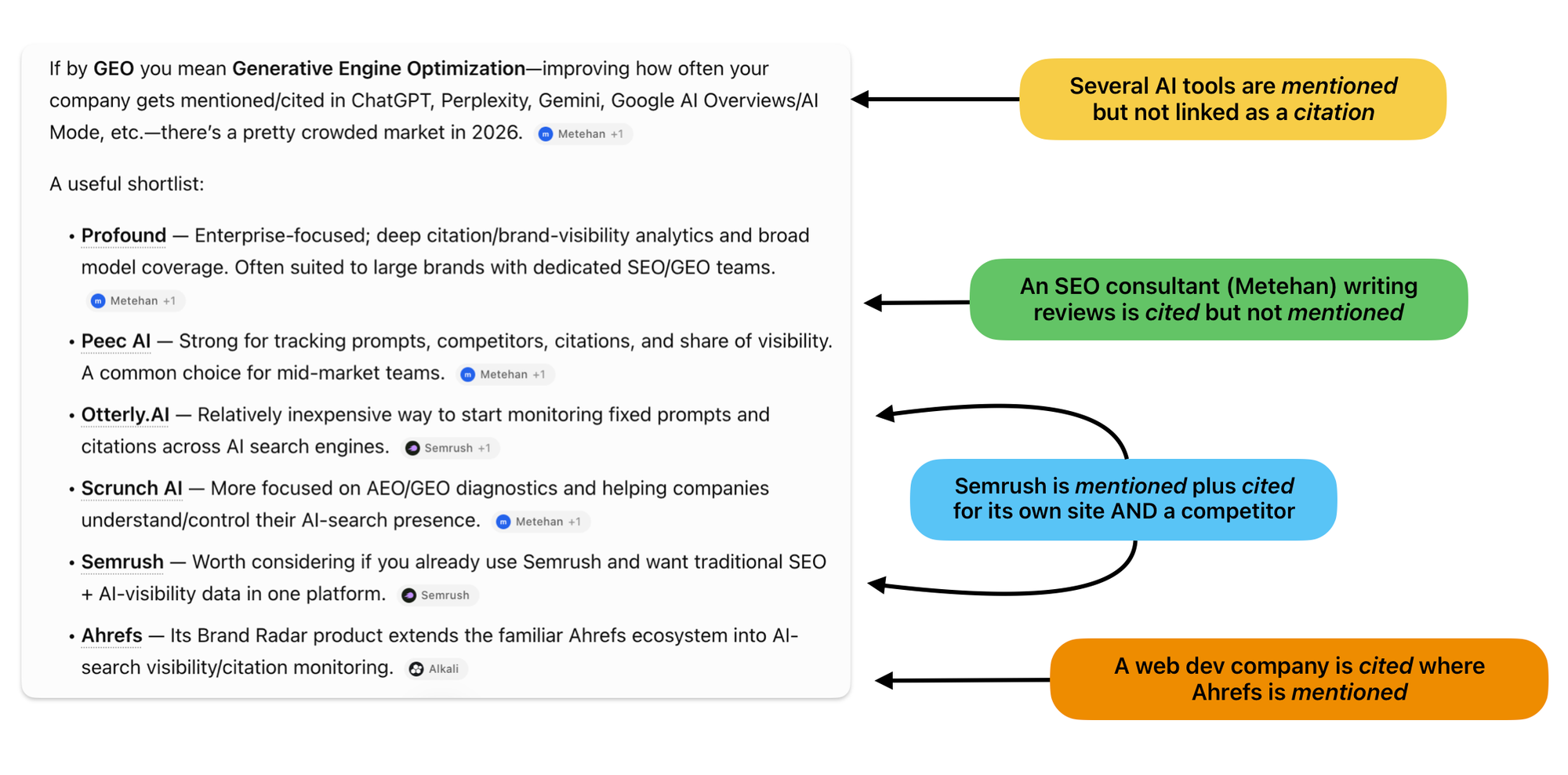
Clearly, it's possible to have your brand mentioned without getting a citation as the primary source or even the secondary. This can happen whether you're a small business or a big player in your industry, like Ahrefs is in the example above.
So which is better? Mentions or citations?
When is a mention or a citation better?
Like many things, it's a best of both worlds scenario: you ideally want both. But if you could only pick one (not that AI models give you any choice)...
Mentions give you broad AI search visibility that has more benefit in B2B applications. In the example above, someone may click through to read the web development company's article about Ahrefs and then decide on their own to go check out the platform. This kind of "do research with AI, then make a mental note and go look it up later" workflow happens a lot more in B2B than B2C industries.
In B2C applications, you're going to want a citation wherever possible, as people are more likely to click through directly from the chat page and buy / subscribe / follow / etc.
How do you get mentions and citations?
Mentions can come from:
- Your own website content, including landing pages and blog posts
- Reviews on third-party platforms like G2
- Your LinkedIn profile and content
- Articles written by third parties that mention you or your brand
- News sources
Citations that include a link to your website can only come from your website. And because many AI searches, especially in the B2B space, are informational, you want to make sure you have:
- Detailed product / service and pricing information on your landing pages
- A blog post library that you regularly add to and update
I would also recommend having an active LinkedIn profile (or company page) and posting feed content or articles with links to your site. You could technically get a citation that links to your LinkedIn profile, too.
Another thing to consider is that mentions may include older content that is part of an AI model's training data. Citations typically happen more with links to the live internet, and may be more likely in retrieval augmented generation (RAG) searches where the AI is actually running Google searches in the background.
What's the criteria for getting mentions and citations?
Getting mentions and citations requires a similar approach to getting "traditional" SEO blue links in search results. You need to:
- Produce good website content that answers real questions and is valuable to the searcher
- Establish trust signals and high authority online by writing thought leadership, getting links back to your website, and building a library of content that's considered to be an authoritative source
- Structure your webpages for good readability
- Make sure you allow large language model (LLM) crawlers to your website...if you block them, they can't show you in search results
You do not need to do any of the following to get a mention or citation:
- Add FAQ schema to your website
- Use excessive bullet lists or tables
- Write super short paragraphs (I'm talking like one line at a time)
- Create a text-only version of your website
Some of the above can actually hurt your SEO / GEO more than it helps!
You can learn more about how to create content, the right way, for AI and traditional search by watching the webinar I ran earlier this year: